From: http://en.naukawpolsce.pl
Jan 19, 2007
Samples of rock and fragments of pyramid walls brought from Egypt are being examined at the AGH University of Science and Technology. It is very likely that meteorites had dropped near the pyramids. The material was collected during the December expedition of geologists. Another aim of the expedition was to study some geoglyphics, i.e. gigantic pictures drawn on the ground
According to "Dziennik Polski", the scientists were intrigued by some unusual structures, which resembled craters formed after meteorites hit the ground. They noticed them when analysing satellite pictures of areas north of the great pyramids in Giza.
“We found very solid metallic fragments in this area. These are probably meteorite fragments” – says Prof. Maciej Pawlikowski from the Mineralogy, Petrography and Geochemistry department at AGH University, who was the supervisor and main organiser of the geological expedition. “We hope that further tests on the patina covering the rocks, which formed during the meteorites’ fall, will help us to establish the exact time of the event” – the scientists said.
The aim of the expedition was also to study the geoglyphics, i.e. gigantic pictures on the ground. Located east of Cairo, they form two several-kilometre-long curved lines, which almost meet in one point. On satellite pictures, they look like a huge drawing of a scarab.
The origins of these mysterious structures remain unknown. “It is not known, whether they are made by man or a natural land formation. Up to now, there have been no publications on the subject” – said Prof. Pawlikowski.
The results of the Krakow geologists’ expedition do not confirm the research of American scientists, who claimed that the pyramids were built from prefabricates.
Showing posts with label science. Show all posts
Showing posts with label science. Show all posts
Saturday, January 24, 2009

MARIJUANA MYTHS

MARIJUANA MYTHS
by Paul Hager
Chair, ICLU Drug Task Force
1. Marijuana causes brain damage
The most celebrated study that claims to show brain damage is the rhesus monkey study of Dr. Robert Heath, done in the late 1970s. This study was reviewed by a distinguished panel of scientists sponsored by the Institute of Medicine and the National Academy of Sciences. Their results were published under the title, Marijuana and Health in 1982. Heath's work was sharply criticized for its insufficient sample size (only four monkeys), its failure to control experimental bias, and the misidentification of normal monkey brain structure as "damaged". Actual studies of human populations of marijuana users have shown no evidence of brain damage. For example, two studies from 1977, published in the Journal of the American Medical Association (JAMA) showed no evidence of brain damage in heavy users of marijuana. That same year, the American Medical Association (AMA) officially came out in favor of decriminalizing marijuana. That's not the sort of thing you'd expect if the AMA thought marijuana damaged the brain.2. Marijuana damages the reproductive system
This claim is based chiefly on the work of Dr. Gabriel Nahas, who experimented with tissue (cells) isolated in petri dishes, and the work of researchers who dosed animals with near-lethal amounts of cannabinoids (i.e., the intoxicating part of marijuana). Nahas' generalizations from his petri dishes to human beings have been rejected by the scientific community as being invalid. In the case of the animal experiments, the animals that survived their ordeal returned to normal within 30 days of the end of the experiment. Studies of actual human populations have failed to demonstrate that marijuana adversely affects the reproductive system.3. Marijuana is a "gateway" drug-it leads to hard drugs
This is one of the more persistent myths. A real world example of what happens when marijuana is readily available can be found in Holland. The Dutch partially legalized marijuana in the 1970s. Since then, hard drug use-heroin and cocaine-have DECLINED substantially. If marijuana really were a gateway drug, one would have expected use of hard drugs to have gone up, not down. This apparent "negative gateway" effect has also been observed in the United States. Studies done in the early 1970s showed a negative correlation between use of marijuana and use of alcohol. A 1993 Rand Corporation study that compared drug use in states that had decriminalized marijuana versus those that had not, found that where marijuana was more available-the states that had decriminalized-hard drug abuse as measured by emergency room episodes decreased. In short, what science and actual experience tell us is that marijuana tends to substitute for the much more dangerous hard drugs like alcohol, cocaine, and heroin.4. Marijuana suppresses the immune system
Like the studies claiming to show damage to the reproductive system, this myth is based on studies where animals were given extremely high-in many cases, near-lethal-doses of cannabinoids. These results have never been duplicated in human beings. Interestingly, two studies done in 1978 and one done in 1988 showed that hashish and marijuana may have actually stimulated the immune system in the people studied.5. Marijuana is much more dangerous than tobacco
Smoked marijuana contains about the same amount of carcinogens as does an equivalent amount of tobacco. It should be remembered, however, that a heavy tobacco smoker consumes much more tobacco than a heavy marijuana smoker consumes marijuana. This is because smoked tobacco, with a 90% addiction rate, is the most addictive of all drugs while marijuana is less addictive than caffeine. Two other factors are important. The first is that paraphernalia laws directed against marijuana users make it difficult to smoke safely. These laws make water pipes and bongs, which filter some of the carcinogens out of the smoke, illegal and, hence, unavailable. The second is that, if marijuana were legal, it would be more economical to have cannabis drinks like bhang (a traditional drink in the Middle East) or tea which are totally non-carcinogenic. This is in stark contrast with "smokeless" tobacco products like snuff which can cause cancer of the mouth and throat. When all of these facts are taken together, it can be clearly seen that the reverse is true: marijuana is much SAFER than tobacco.6. Legal marijuana would cause carnage on the highways
Although marijuana, when used to intoxication, does impair performance in a manner similar to alcohol, actual studies of the effect of marijuana on the automobile accident rate suggest that it poses LESS of a hazard than alcohol. When a random sample of fatal accident victims was studied, it was initially found that marijuana was associated with RELATIVELY as many accidents as alcohol. In other words, the number of accident victims intoxicated on marijuana relative to the number of marijuana users in society gave a ratio similar to that for accident victims intoxicated on alcohol relative to the total number of alcohol users. However, a closer examination of the victims revealed that around 85% of the people intoxicated on marijuana WERE ALSO INTOXICATED ON ALCOHOL. For people only intoxicated on marijuana, the rate was much lower than for alcohol alone. This finding has been supported by other research using completely different methods. For example, an economic analysis of the effects of decriminalization on marijuana usage found that states that had reduced penalties for marijuana possession experienced a rise in marijuana use and a decline in alcohol use with the result that fatal highway accidents decreased. This would suggest that, far from causing "carnage", legal marijuana might actually save lives.7. Marijuana "flattens" human brainwaves
This is an out-and-out lie perpetrated by the Partnership for a Drug-Free America. A few years ago, they ran a TV ad that purported to show, first, a normal human brainwave, and second, a flat brainwave from a 14-year-old "on marijuana". When researchers called up the TV networks to complain about this commercial, the Partnership had to pull it from the air. It seems that the Partnership faked the flat "marijuana brainwave". In reality, marijuana has the effect of slightly INCREASING alpha wave activity. Alpha waves are associated with meditative and relaxed states which are, in turn, often associated with human creativity.8. Marijuana is more potent today than in the past
This myth is the result of bad data. The researchers who made the claim of increased potency used as their baseline the THC content of marijuana seized by police in the early 1970s. Poor storage of this marijuana in un-air conditioned evidence rooms caused it to deteriorate and decline in potency before any chemical assay was performed. Contemporaneous, independent assays of unseized "street" marijuana from the early 1970s showed a potency equivalent to that of modern "street" marijuana. Actually, the most potent form of this drug that was generally available was sold legally in the 1920s and 1930s by the pharmaceutical company Smith-Klein under the name, "American Cannabis".9. Marijuana impairs short-term memory
This is true but misleading. Any impairment of short-term memory disappears when one is no longer under the influence of marijuana. Often, the short-term memory effect is paired with a reference to Dr. Heath's poor rhesus monkeys to imply that the condition is permanent.10. Marijuana lingers in the body like DDT
This is also true but misleading. Cannabinoids are fat soluble as are innumerable nutrients and, yes, some poisons like DDT. For example, the essential nutrient, Vitamin A, is fat soluble but one never hears people who favor marijuana prohibition making this comparison.11. There are over a thousand chemicals in marijuana smoke
Again, true but misleading. The 31 August 1990 issue of the magazine Science notes that of the over 800 volatile chemicals present in roasted COFFEE, only 21 have actually been tested on animals and 16 of these cause cancer in rodents. Yet, coffee remains legal and is generally considered fairly safe.12. No one has ever died of a marijuana overdose
This is true. It was put in to see if you are paying attention. Animal tests have revealed that extremely high doses of cannabinoids are needed to have lethal effect. This has led scientists to conclude that the ratio of the amount of cannabinoids necessary to get a person intoxicated (i.e., stoned) relative to the amount necessary to kill them is 1 to 40,000. In other words, to overdose, you would have to consume 40,000 times as much marijuana as you needed to get stoned. In contrast, the ratio for alcohol varies between 1 to 4 and 1 to 10. It is easy to see how upwards of 5000 people die from alcohol overdoses every year and no one EVER dies of marijuana overdoses.WHAT IS THE ICLU DRUG TASK FORCE?
The Indiana Civil Liberties Union (ICLU) Drug Task Force is involved in education and lobbying efforts directed toward reforming drug policy. Specifically, we support ACLU Policy Statement number 210 which calls for the legalization of marijuana. We also support an end to the drug war. In its place, we favor "harm reduction" strategies which treat drug abuse as what it is- a medical problem-rather than a criminal justice problem.The Drug Task Force also works to end urine and hair testing of workers by private industry. These kinds of tests violate worker privacy to no good purpose because they detect past use of certain drugs (mostly marijuana) while ignoring others (e.g., LSD) and cannot detect current impairment. In situations where public and worker safety is a legitimate concern, we advocate impairment testing devices which reliably detect degradation of performance without infringing upon worker privacy.
For more information about the activities of the Drug Task Force, call the ICLU at (317) 635-4059 or call Paul Hager at (812) 333-1384 or e-mail to hagerp@cs.indiana.edu on the InterNet.
SOURCES
Spread this around!
Waves work in a constant up-and-down movement, back and forth, and the WaveReaper, a simple mechanical device, takes advantage of this in a cheap way. As we said, the wave moves up and down, while most generators, rotate around an axle, and the wave size varies a lot, and creating problems, when you want to utilize their energy content. The current technologies regarding wave energy today is very costly, which means they can't compete with other ways of making energy. The technology can also be used to save the shoreline from The North Sea, Causing havoc in northern of Europe in Great Britain.

Onshore WaveReaper
This is a simple schematic, showing buoy, wire and one-way bearing, connected together. In case of storm and rough waves, it is a problem, for all wave energy constructions, however, the Wavereaper™, has a built in safety feature in its construction, that would avoid damage on the equipment, its due to the max lifting force of the barrels, since they will sink under the surface, if the force is to great. this will make the Wavereaper possible to work in any weather, however it should be constructed, to take advantage, of the medium wave, that is present at all time, for best cost benefit of the plant.
Another factor, water, and generators, yes, almost any technology, is having problem, when it comes to the oceans salty water without more expensive design and material. Water can leak inside equipment and ruin electrical circuits, and it must therefore be safeguarded against corrosion, and in those cases it is under water, against leakage, corrosion and pressure. Also water-depth, and the special environment, which crave divers, and other expensive equipment, has made wave energy very costly.
With other words, underwater technology is not cheap, and with these problems to solve, which means high costs, and therefore more expensive energy for the consumer. This is not what we would like, so it is need to solve the wave energy generation concept, to go around these problems. And the solution is simple, we can use basic items, as wire, plastic barrels, one way bearings, pulley, an axle, flywheel and generator.
That is the main components, in what up to day, would be the cheapest wave energy technology in the world. It can even be built in wood or by choice bicycle parts! This is very good, in countries which have limited access to expensive metals, and heavy machining tools. Most of the parts in a WaveReaper generator, except wiring, can be made of wood, plastics or more expensive metal.

WaveReaper plastic barrels in the waves.
We will use a set of plastic barrels as boys, cost is low, and PVC isn't affected by salty ocean water. The barrels are placed near shore or longer out in deeper water, depending on amount of energy needed in particular wave plant. The Barrels will also help for erosion problems in shoreline. For example in England.

Power transmitting wires, and aluminium pipes controlling the blocks.
To avoid the need for divers, and also avoid the need to have boats when the WaveReaper is deployed an special aluminium pipe is used. The pipe is mounted in sections, and prolonged further out in the sea. I think it is possible to have distances up to 300 meters from the shoreline, to get access to greaters dephts, where also the waves is greater. Lifting containers have to provide lifting force to the pipe, and right under every barrel wich is producing power to the onshore WaveReaper generator, a round plate is placed, this plate will prohibit the lifting force the rising barrel will have on the pipe,
The pipe remains steady approx 5 meters under the water. This design will ensure that the operation of the WaceReaper plant can be done from the shoreline only, without need for divers, and without need for boats, wich is normally used when it comes to wave power generation.
This is bringing down service cost, and also the level of education needed to run the plant is lesser, when noone have to dive. Diving is a very costly part of operation of a wave generator. If something happens with the blocks wires or barrels, the pipe can easy be hauled onto shore, and repaired or replaced.
The barrels is on 2 meters distance from each other, and connected to the on mainland placed WaveReaper generator, via the “power transmitting wire” it is also is connected with a thinner wire, between them, so, if the power wire should break, the barrels, don’t get to drift away, in the sea. This will also even out the possibility that the barrels, would smash into each other, when the sea is rougher.

The Aluminium pipe can be burried in gravel and sand for inexpensive building.
The lifting capacity is also setting a maximum power input into the device, since if it is large and fast waves, the barrels would not lift more than it can, and forces is kept within its chosen range, chosen when constructing the WaveReaper plant.

Power out put of waves kW per meter of WaveReaper, approximated 30% energy after conversion.
I have chosen to use cheap materials only, in this demonstration, because the need to bring down production costs, and make it possible to build this type of wave generation device, any where in the world, and with local materials, as car parts etc, which doesn't needs to be imported. Other materials could of course be used, and the schematics for its design of course, be different. Simple is better, it is said, and fewer parts, and bearings, will bring lower cost of building, and also repair.

Front Scematics WaveReaper
The wire is connected to a chain in the end, witch works on a gearwheel sitting on a one-way bearing, mounted on an axle. This translates the pulling force of the wire, to an circular movement which is good for cheap generators. The wire is for this case 4 mm stainless steel, which give a lifting ability of approx 300 Kg before it brakes. Also plastic can be used as the Pvc band, which today is commonly used for packaging goods on pallets, this type of PVC band has high strength, and is also light, and cost-effective, of course the UV light from the sun is affecting it in the long run, but the part that is in the water, should be somewhat guarded from the UV rays.
Flywheels is also mounted on the axle, to collect, even out and store the momentum which is produced by the lifting barrel, this will even out and, smooth the turning's of the axle, to the generator, which is driven by a pulley, who will give it correct rpm. A simple brake, which can never wear down, is also planned, in those cases, constant current generators, or a special electronics device is not used.

Profile Scematics WaveReaper
When the wire is coming up to the generator housing, a chain is mounted to the wire, which drive the Gear wheel, and the one way bearing, which makes the chain draw, when the waves raises the barrel, but let it spin freely back, when the wave height is going down again, also a small weight is connected to the chain, to make it even out slack of the wire. A flywheel is mounted, and a pulley drives the generator, evenly.

Suggested Prototype Design
One-way bearing, with pulley and wire, and with bigger loads, chain and gearwheel, is an option. One-way bearings can be seen in ex. bicycles, the rotate freely in one direction, but in the other direction, they grip, and transfer force, this is used in the Wave reaper, and makes it simple, and cost effective. The waves up and down, movement is translated to rotating movement, suited for a generator, of choice.

Suggested Prototype Design
The Benefits of the One-way bearing.
The barrels will of course jump up and down in random patterns; this will add to an even movement of the generator axle, and its flywheel, as soon as a wave has energy to contribute, it will transmit its force to the wire, and to the axle. The flywheel is storing the momentum gained from the waves temporarily.
Because of its design, the WaveReaper, is always self adjusting regarding wave height, and tidal shifts, and higher or lower water levels due to shifting weather patterns, no adjustment needed, the Wavereaper™ is always balancing itself out, to optimal level in the ocean.

500 Kilowatt to 1 Megawatt Plant
Example: number of barrels in each row 10, and rows 10, the plant would be 20 x 20 meters of area, 400m2, and will have 100 connected wires, which transfer the mechanical energy, to the generator. This type of plants, give 100 to 500 kW every hour, which generates profits, of 6500 to 25 000 dollars of revenue monthly, building cost of the plant is estimated to 20 000 dollars only. This will give that the WaveReaper earns itself, in a few months, instead of many many years!
No complicated technology is needed, which would need delicate conditions, or a lot of service. This technology, offered globally for free, Anyone can now build his very own, generator.

Let everyone know, friend and foe, its time for things to change in the worlds energy sector. Oil based economy, is not needed anymore, lets all accept it, and build a better world, lets feed the hungry, cure the sick, and of course, stop polluting the environment, with the oil based stone age technology.
OFFSHORE WaveReaper Giga to Terra Watt Design
Here Is the Offshore Wavereaper design, and as pictures show, we can now use one single axle to the generatorset, wich brings alot of power onto the single generator, wich can be very big in size.

View From Top

View From Front

View From Side Showing Sloaping angle
This Design Can Choose power output easy

Thanks From The Inventors Team
Friday, January 2, 2009
Study: Diamonds link comet to mammal extinction
(CNN) -- Tiny diamonds found in the soil are "strong evidence" a comet exploded on or above North America nearly 13,000 years ago, leading to the extinction of dozens of mammal species, according to a study.
 The scientific report also suggests the cataclysm also reduced the population of the earliest people to inhabit the region and triggered a 1,300-year-long cold spell that stretched around the world.
The heat generated by the extraterrestrial impact likely melted much of a glacier that once covered the Great Lakes region, sending a massive flood down the Mississippi River, the study said.
According to the report, the cold waves of glacial runoff into the Gulf of Mexico shifted Atlantic Ocean currents, changing climate patterns throughout the world in a cooling period known as the Younger Dryas.
"A rare swarm" of comets rained over North America about 12,900 years ago, sparking fires that produced choking, leading "to the extinction of a large range of animals, including mammoths, across North America," the report said.
The study was conducted by a group of eight archaeologists and geologists from the universities of Oregon and California, Northern Arizona University, Oklahoma University and DePaul University. Their findings were published Friday in the journal Nature. iReport.com: Have you ever seen a comet? Show us
The prehistoric humans known to have inhabited the continent at the time of the event -- hunters and gatherers dubbed the Clovis culture -- suffered a major decline in population in the aftermath, the scientists said.
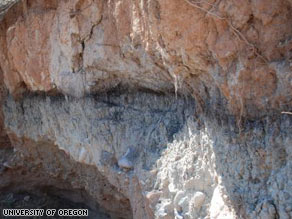
The scientists studied layers of sediment dated to 12,900 years ago at six North American locations, including one directly on top of a Clovis site in Murray Springs, Arizona. Each layer was rich in nanodiamonds, which are produced under high-temperature, high-pressure conditions created by cosmic impacts, the report said.
"The nanodiamonds that we found at all six locations exist only in sediments associated with the Younger Dryas Boundary layers, not above it or below it," said University of Oregon archaeologist Douglas Kennett. "These discoveries provide strong evidence for a cosmic impact event at approximately 12,900 years ago that would have had enormous environmental consequences for plants, animals and humans across North America."
The other sites studied were in Bull Creek, Oklahoma; Gainey, Michigan and Topper, South Carolina, as well as Lake Hind, Manitoba; and Chobot, in the Canadian province of Alberta
Diamonds found in North American soil suggest a comet led to the extinction of dozens of mammal species.
The heat generated by the extraterrestrial impact likely melted much of a glacier that once covered the Great Lakes region, sending a massive flood down the Mississippi River, the study said.
According to the report, the cold waves of glacial runoff into the Gulf of Mexico shifted Atlantic Ocean currents, changing climate patterns throughout the world in a cooling period known as the Younger Dryas.
"A rare swarm" of comets rained over North America about 12,900 years ago, sparking fires that produced choking, leading "to the extinction of a large range of animals, including mammoths, across North America," the report said.
The study was conducted by a group of eight archaeologists and geologists from the universities of Oregon and California, Northern Arizona University, Oklahoma University and DePaul University. Their findings were published Friday in the journal Nature. iReport.com: Have you ever seen a comet? Show us
The prehistoric humans known to have inhabited the continent at the time of the event -- hunters and gatherers dubbed the Clovis culture -- suffered a major decline in population in the aftermath, the scientists said.
The scientists studied layers of sediment dated to 12,900 years ago at six North American locations, including one directly on top of a Clovis site in Murray Springs, Arizona. Each layer was rich in nanodiamonds, which are produced under high-temperature, high-pressure conditions created by cosmic impacts, the report said.
"The nanodiamonds that we found at all six locations exist only in sediments associated with the Younger Dryas Boundary layers, not above it or below it," said University of Oregon archaeologist Douglas Kennett. "These discoveries provide strong evidence for a cosmic impact event at approximately 12,900 years ago that would have had enormous environmental consequences for plants, animals and humans across North America."
The other sites studied were in Bull Creek, Oklahoma; Gainey, Michigan and Topper, South Carolina, as well as Lake Hind, Manitoba; and Chobot, in the Canadian province of Alberta
Thursday, January 1, 2009
Wednesday, December 10, 2008
Saturday, November 8, 2008
The GM genocide: Thousands of Indian farmers are committing suicide after using genetically modified crops
By Andrew Malone
Last updated at 12:48 AM on 03rd November 2008



Last updated at 12:48 AM on 03rd November 2008
When Prince Charles claimed thousands of Indian farmers were killing themselves after using GM crops, he was branded a scaremonger. In fact, as this chilling dispatch reveals, it's even WORSE than he feared.
The children were inconsolable. Mute with shock and fighting back tears, they huddled beside their mother as friends and neighbours prepared their father's body for cremation on a blazing bonfire built on the cracked, barren fields near their home.
As flames consumed the corpse, Ganjanan, 12, and Kalpana, 14, faced a grim future. While Shankara Mandaukar had hoped his son and daughter would have a better life under India's economic boom, they now face working as slave labour for a few pence a day. Landless and homeless, they will be the lowest of the low.
Human tragedy: A farmer and child in India's 'suicide belt'
Shankara, respected farmer, loving husband and father, had taken his own life. Less than 24 hours earlier, facing the loss of his land due to debt, he drank a cupful of chemical insecticide.
Unable to pay back the equivalent of two years' earnings, he was in despair. He could see no way out.
There were still marks in the dust where he had writhed in agony. Other villagers looked on - they knew from experience that any intervention was pointless - as he lay doubled up on the ground, crying out in pain and vomiting.
Moaning, he crawled on to a bench outside his simple home 100 miles from Nagpur in central India. An hour later, he stopped making any noise. Then he stopped breathing. At 5pm on Sunday, the life of Shankara Mandaukar came to an end.
As neighbours gathered to pray outside the family home, Nirmala Mandaukar, 50, told how she rushed back from the fields to find her husband dead. 'He was a loving and caring man,' she said, weeping quietly.
'But he couldn't take any more. The mental anguish was too much. We have lost everything.'
Shankara's crop had failed - twice. Of course, famine and pestilence are part of India's ancient story.
But the death of this respected farmer has been blamed on something far more modern and sinister: genetically modified crops.
Shankara, like millions of other Indian farmers, had been promised previously unheard of harvests and income if he switched from farming with traditional seeds to planting GM seeds instead.
Distressed: Prince Charles has set up charity Bhumi Vardaan Foundation to address the plight of suicide farmers
Beguiled by the promise of future riches, he borrowed money in order to buy the GM seeds. But when the harvests failed, he was left with spiralling debts - and no income.
So Shankara became one of an estimated 125,000 farmers to take their own life as a result of the ruthless drive to use India as a testing ground for genetically modified crops.
The crisis, branded the 'GM Genocide' by campaigners, was highlighted recently when Prince Charles claimed that the issue of GM had become a 'global moral question' - and the time had come to end its unstoppable march.
Speaking by video link to a conference in the Indian capital, Delhi, he infuriated bio-tech leaders and some politicians by condemning 'the truly appalling and tragic rate of small farmer suicides in India, stemming... from the failure of many GM crop varieties'.
Ranged against the Prince are powerful GM lobbyists and prominent politicians, who claim that genetically modified crops have transformed Indian agriculture, providing greater yields than ever before.
The rest of the world, they insist, should embrace 'the future' and follow suit.
So who is telling the truth? To find out, I travelled to the 'suicide belt' in Maharashtra state.
What I found was deeply disturbing - and has profound implications for countries, including Britain, debating whether to allow the planting of seeds manipulated by scientists to circumvent the laws of nature.
For official figures from the Indian Ministry of Agriculture do indeed confirm that in a huge humanitarian crisis, more than 1,000 farmers kill themselves here each month.
Simple, rural people, they are dying slow, agonising deaths. Most swallow insecticide - a pricey substance they were promised they would not need when they were coerced into growing expensive GM crops.
It seems that many are massively in debt to local money-lenders, having over-borrowed to purchase GM seed.
Pro-GM experts claim that it is rural poverty, alcoholism, drought and 'agrarian distress' that is the real reason for the horrific toll.
But, as I discovered during a four-day journey through the epicentre of the disaster, that is not the full story.
Death seeds: A Greenpeace protester sprays milk-based paint on a Monsanto research soybean field near Atlantic, Iowa
In one small village I visited, 18 farmers had committed suicide after being sucked into GM debts. In some cases, women have taken over farms from their dead husbands - only to kill themselves as well.
Latta Ramesh, 38, drank insecticide after her crops failed - two years after her husband disappeared when the GM debts became too much.
She left her ten-year-old son, Rashan, in the care of relatives. 'He cries when he thinks of his mother,' said the dead woman's aunt, sitting listlessly in shade near the fields.
Village after village, families told how they had fallen into debt after being persuaded to buy GM seeds instead of traditional cotton seeds.
The price difference is staggering: £10 for 100 grams of GM seed, compared with less than £10 for 1,000 times more traditional seeds.
But GM salesmen and government officials had promised farmers that these were 'magic seeds' - with better crops that would be free from parasites and insects.
Indeed, in a bid to promote the uptake of GM seeds, traditional varieties were banned from many government seed banks.
The authorities had a vested interest in promoting this new biotechnology. Desperate to escape the grinding poverty of the post-independence years, the Indian government had agreed to allow new bio-tech giants, such as the U.S. market-leader Monsanto, to sell their new seed creations.
In return for allowing western companies access to the second most populated country in the world, with more than one billion people, India was granted International Monetary Fund loans in the Eighties and Nineties, helping to launch an economic revolution.
But while cities such as Mumbai and Delhi have boomed, the farmers' lives have slid back into the dark ages.
Though areas of India planted with GM seeds have doubled in two years - up to 17 million acres - many famers have found there is a terrible price to be paid.
Far from being 'magic seeds', GM pest-proof 'breeds' of cotton have been devastated by bollworms, a voracious parasite.
Nor were the farmers told that these seeds require double the amount of water. This has proved a matter of life and death.
With rains failing for the past two years, many GM crops have simply withered and died, leaving the farmers with crippling debts and no means of paying them off.
Having taken loans from traditional money lenders at extortionate rates, hundreds of thousands of small farmers have faced losing their land as the expensive seeds fail, while those who could struggle on faced a fresh crisis.
When crops failed in the past, farmers could still save seeds and replant them the following year.
But with GM seeds they cannot do this. That's because GM seeds contain so- called 'terminator technology', meaning that they have been genetically modified so that the resulting crops do not produce viable seeds of their own.
As a result, farmers have to buy new seeds each year at the same punitive prices. For some, that means the difference between life and death.
Take the case of Suresh Bhalasa, another farmer who was cremated this week, leaving a wife and two children.
As night fell after the ceremony, and neighbours squatted outside while sacred cows were brought in from the fields, his family had no doubt that their troubles stemmed from the moment they were encouraged to buy BT Cotton, a geneticallymodified plant created by Monsanto.
'We are ruined now,' said the dead man's 38-year-old wife. 'We bought 100 grams of BT Cotton. Our crop failed twice. My husband had become depressed. He went out to his field, lay down in the cotton and swallowed insecticide.'
Villagers bundled him into a rickshaw and headed to hospital along rutted farm roads. 'He cried out that he had taken the insecticide and he was sorry,' she said, as her family and neighbours crowded into her home to pay their respects. 'He was dead by the time they got to hospital.'
Asked if the dead man was a 'drunkard' or suffered from other 'social problems', as alleged by pro-GM officials, the quiet, dignified gathering erupted in anger. 'No! No!' one of the dead man's brothers exclaimed. 'Suresh was a good man. He sent his children to school and paid his taxes.
'He was strangled by these magic seeds. They sell us the seeds, saying they will not need expensive pesticides but they do. We have to buy the same seeds from the same company every year. It is killing us. Please tell the world what is happening here.'
Monsanto has admitted that soaring debt was a 'factor in this tragedy'. But pointing out that cotton production had doubled in the past seven years, a spokesman added that there are other reasons for the recent crisis, such as 'untimely rain' or drought, and pointed out that suicides have always been part of rural Indian life.
Officials also point to surveys saying the majority of Indian farmers want GM seeds - no doubt encouraged to do so by aggressive marketing tactics.
During the course of my inquiries in Maharastra, I encountered three 'independent' surveyors scouring villages for information about suicides. They insisted that GM seeds were only 50 per cent more expensive - and then later admitted the difference was 1,000 per cent.
(A Monsanto spokesman later insisted their seed is 'only double' the price of 'official' non-GM seed - but admitted that the difference can be vast if cheaper traditional seeds are sold by 'unscrupulous' merchants, who often also sell 'fake' GM seeds which are prone to disease.)
With rumours of imminent government compensation to stem the wave of deaths, many farmers said they were desperate for any form of assistance. 'We just want to escape from our problems,' one said. 'We just want help to stop any more of us dying.'
Prince Charles is so distressed by the plight of the suicide farmers that he is setting up a charity, the Bhumi Vardaan Foundation, to help those affected and promote organic Indian crops instead of GM.
India's farmers are also starting to fight back. As well as taking GM seed distributors hostage and staging mass protests, one state government is taking legal action against Monsanto for the exorbitant costs of GM seeds.
This came too late for Shankara Mandauker, who was 80,000 rupees (about £1,000) in debt when he took his own life. 'I told him that we can survive,' his widow said, her children still by her side as darkness fell. 'I told him we could find a way out. He just said it was better to die.'
But the debt does not die with her husband: unless she can find a way of paying it off, she will not be able to afford the children's schooling. They will lose their land, joining the hordes seen begging in their thousands by the roadside throughout this vast, chaotic country.
Cruelly, it's the young who are suffering most from the 'GM Genocide' - the very generation supposed to be lifted out of a life of hardship and misery by these 'magic seeds'.
Friday, October 31, 2008
Ultrasound Shown to Exert Remote Control of Brain Circuits
| Source: Arizona State University College of Liberal Arts and Sciences | Released: Wed 29-Oct-2008, 08:00 ET Embargo expired: Wed 29-Oct-2008, 00:00 ET
|
Ultrasound Shown to Exert Remote Control of Brain Circuits
| Libraries Science News | Keywords ULTRASOUND, BRAIN, ELECTRICAL ACTIVITY, GAMING, NEUROSTIMULATION, NON INVASIVE TREATMENTS, BIOMEDICAL, ALZHEIMER'S, STROKE RECOVERY, TRANSLATIONAL RESEARCH | |
Contact Information Available for logged-in reporters only | ||
Description In a twist on nontraditional uses of ultrasound, a group of neuroscientists at Arizona State University has developed pulsed ultrasound techniques that can remotely stimulate brain circuit activity. Their findings, published in the Oct. 29 issue of the journal Public Library of Science (PLoS) One, provide insights into how low-power ultrasound can be harnessed for the noninvasive neurostimulation of brain circuits and offers the potential for new treatments of brain disorders and disease. | ||
| |
 |
| |
|
| |
Newswise — In a twist on nontraditional uses of ultrasound, a group of neuroscientists at Arizona State University has developed pulsed ultrasound techniques that can remotely stimulate brain circuit activity. Their findings, published in the Oct. 29 issue of the journal Public Library of Science (PLoS) One, provide insights into how low-power ultrasound can be harnessed for the noninvasive neurostimulation of brain circuits and offers the potential for new treatments of brain disorders and disease.
While it might be hard to imagine the day where doctors could treat post traumatic stress disorders, traumatic brain injury and even Alzheimer’s disease with the flip of a switch, most of us have in fact experienced some of ultrasound’s numerous applications in our daily lives. For example, ultrasound has been used in fetal and other diagnostic medical imaging, ultrasonic teeth cleaning, physiotherapies, or surgical ablation. Ultrasound also provides a multitude of other non-medical uses, including pharmaceutical manufacturing, food processing, nondestructive materials testing, sonar, communications, oceanography and acoustic mapping.
“Studies of ultrasound and its interactions with biological tissues have a rich history dating back to the late 1920s,” lead investigator William “Jamie” Tyler points out. “Several research groups have, for more than a half-century, demonstrated that ultrasound can produce changes in excitable tissues, such as nerve and/or muscle, but detailed studies in neurons at the cellular level have been lacking.”
“We were able to unravel how ultrasound can stimulate the electrical activity of neurons by optically monitoring the activity of neuronal circuits, while we simultaneously propagated low-intensity, low-frequency ultrasound through brain tissues,” says Tyler, assistant professor of neurobiology and bioimaging in the School of Life Sciences in the College of Liberal Arts and Sciences.
Led by Tyler, the ASU research group discovered that remotely delivered low intensity, low frequency ultrasound (LILFU) increased the activity of voltage-gated sodium and calcium channels in a manner sufficient to trigger action potentials and the release of neurotransmitter from synapses. Since these processes are fundamental to the transfer of information among neurons, the authors pose that this type of ultrasound provides a powerful new tool for modulating the activity of neural circuits.
“Many of the stimulation methods used by neuroscientists require the use and implantation of stimulating electrodes, requiring direct contact with nervous tissue or the introduction of exogenous proteins, such as those used for the light-activation of neurons,” Tyler explains.
The search for new types of noninvasive neurostimulation methods led them to revisit ultrasound.
“We were quite surprised to find that ultrasound at power levels lower than those typically used in routine diagnostic medical imaging procedures could produce an increase in the activity of neurons while higher power levels produced very little effect on their activity,” Tyler says.
Other neuroscientists and engineers have also been rapidly developing new neurostimulation methods for controlling nervous system activity and several approaches show promise for the treatment of a wide variety of nervous system disorders. For example, Deep Brain Stimulation (DBS) and Vagal Nerve Stimulation (VNS) have been shown to be effective in the management of psychiatric disorders such as depression, bipolar disorders, post-traumatic stress disorder, and drug addition, as well as for therapies of neurological diseases such as Parkinson’s disease, Alzheimer’s disease, Tourette Syndrome, epilepsy, dystonia, stuttering, tinnitus, recovery of cognitive and motor function following stroke, and chronic pain. Up until now, these two techniques have captured the attention of physicians and scientists; however, these therapies still pose risks to patients because they require the surgical implantation of stimulating electrodes. Thus, these types of therapies are often only available to patients presenting the worst of prognoses.
One prior stumbling block to using ultrasound noninvasively in the brain has been the skull. However, the acoustic frequencies utilized by Tyler and his colleagues to construct their pulsed ultrasound waveforms, overlap with a frequency range where optimal energy gains are achieved between transcranial transmission and brain absorption of ultrasound – which allows the ultrasound to penetrate bone and yet prevent damage to the soft tissues. Their findings are supported by other studies examining the potential of high-intensity focused ultrasound for ablating brain tissues, where it was shown that low-frequency ultrasound could be focused through human skulls.
When asked about the potential of using his groups’ methods to remotely control brain activity, Tyler says: “One might be able to envision potential applications ranging from medical interventions to use in video gaming or the creation of artificial memories along the lines of Arnold Schwarzenegger’s character in ‘Total Recall.’ Imagine taking a vacation without actually going anywhere?”
“Obviously, we need to conduct further research and development, but one of the most exhilarating prospects is that low intensity, low frequency ultrasound permit deep-brain stimulation procedures without requiring exogenous proteins or surgically implanted medical devices,” he adds.
Tyler and the other ASU researchers will now focus on further characterization of the influence of ultrasound on intact brain circuits and translational research, taking low intensity ultrasound from the lab into pre-clinical trials and treatment of neurological diseases.Friday, July 4, 2008
House passes bill mandating a plan for asteroid warning and deflection
House passes bill mandating a plan for asteroid warning and deflection
KurzweilAI.net, June 27, 2008
The Apophis asteroid is expected to pass at a distance from Earth that is closer than geostationary satellites in 2029.
The bill would also require the Director of the White House's Office of Science and Technology Policy (OSTP) to develop a policy within two years for notifying Federal agencies and relevant emergency response institutions of an impending near-Earth object threat. And the OSTP would be required to recommend a Federal agency (or agencies) to be responsible for protecting the Nation from any near-Earth object anticipated to collide with Earth, and for implementing a deflection campaign.
Thursday, July 3, 2008
Earth's Core, Magnetic Field Changing Fast, Study Says
Rapid changes in the churning movement of Earth's liquid outer core are weakening the magnetic field in some regions of the planet's surface, a new study says.
"What is so surprising is that rapid, almost sudden, changes take place in the Earth's magnetic field," said study co-author Nils Olsen, a geophysicist at the Danish National Space Center in Copenhagen.
The findings suggest similarly quick changes are simultaneously occurring in the liquid metal, 1,900 miles (3,000 kilometers) below the surface, he said.
The swirling flow of molten iron and nickel around Earth's solid center triggers an electrical current, which generates the planet's magnetic field.
(Learn more about Earth's interior.)
The study, published recently in Nature Geoscience, modeled Earth's magnetic field using nine years of highly accurate satellite data. - Continue
"What is so surprising is that rapid, almost sudden, changes take place in the Earth's magnetic field," said study co-author Nils Olsen, a geophysicist at the Danish National Space Center in Copenhagen.
The findings suggest similarly quick changes are simultaneously occurring in the liquid metal, 1,900 miles (3,000 kilometers) below the surface, he said.
The swirling flow of molten iron and nickel around Earth's solid center triggers an electrical current, which generates the planet's magnetic field.
(Learn more about Earth's interior.)
The study, published recently in Nature Geoscience, modeled Earth's magnetic field using nine years of highly accurate satellite data. - Continue
Thursday, April 24, 2008
PHOENIX -- Strange lights appeared above the Valley sky in formation on Monday night.
Witnesses said the lights formed a vertical line, then a diamond shape, followed by a u-shape.
The lights reportedly moved from side to side and upward before disappearing one by one.-Continue
The lights reportedly moved from side to side and upward before disappearing one by one.-Continue
Subscribe to:
Posts (Atom)