Showing posts with label martial law. Show all posts

Monday, April 6, 2009

EMP -- a deadly kink in our armor!


EMP -- a deadly kink in our armor!

by Dan Eden for Viewzone

As usual, viewzone gave me a writing assignment about something of which I knew very little -- this time it was something called the electromagnetic pulse, or "EMP" weapon. As usual, what I learned from my research scared the hell out of me.

When I first sat down to write this story, America had no real enemy capable of using an EMP weapon. That's a good thing because, as you will learn, this is far more dangerous and potentially more lethal than a nuclear bomb. But now, as I am forced to re-write this article for publication, our old nemesis -- Russia -- has emerged as a potential foe. Not only do the Russians have EMP weapons but the likelihood of their use, especially if the geo-political tensions continue, is almost certain.

First, let me emphasize this: Unlike nuclear bombs that can destroy a large city like New York or Chicago, an EMP weapon is so powerful that just one -- detonated over the central USA -- could knock out the entire country. That's right -- just one!

EMP -- the worst weapon you will ever survive.

When I was a teenager I was a ham radio operator. I listened to my short wave radio for hours just about every day. I remember one summer in 1962 when I thought my receiver was broken; I even bought new tubes for it. On every band, on every frequency, there was a loud and annoying hiss that lasted for a couple of days. Communication was impossible.

No one spoke about it on the news, nothing was written -- it was "top secret" at the time -- but I later learned that it was the result of an atmospheric nuclear explosion. The 1.4 megaton detonation, called "Operation Starfish Prime" [right] occurred 250 miles above Johnston Island in the Pacific. Not only did the explosion shut down short wave radio communications in America, but it also overloaded and blew out over 300 streetlights in Oahu, Hawaii -- some 740 miles away!

Scientists learned that nuclear explosions, in addition to the blast, heat and deadly gamma radiation, also produce a strong electromagnetic pulse that is capable of passing thousands of volts of electrical energy to just about anything that conducts electricity.

The pulse is generated by the interaction of gamma rays, released by a nuclear explosion, with the atmosphere and the Earth. Called the "Compton effect", the resulting pulse is like a radio signal and any metallic object acts like a receiving antenna. Whereas a radio signal might produce a thousandth of a volt or less in a receiving antenna, an EMP pulse produces thousands of volts. Antennae, pipelines, underground gas and water pipes, metal fences, iron railroad tracks, power lines, telephone wires, electric cables -- all suddenly act like antennae and become the recipient of huge currents, starting fires, explosions and frying all forms of circuitry beyond repair.

Because our bodies do not conduct this current, the EMP does not directly harm humans or other living organisms. But, as you will see, that's not necessarily good news.

Back to the stone age

Look around you. Right now you are using a computer. You probably also depend on a cellphone and, most likely, you have a car to get you from home to work or to the market.

Most vulnerable to this high current of EMP are transistors, those small devices that are inside computer chips, radios, cellphones, ATM machines, automotive ingnition systems, calculators, clocks and just about everything that requires batteries. All of these would be useless after an EMP and repairing them would not be an option. They would all have to be replaced.

An EMP lasts just 1 nano-second! It radiates at 50 kv/m at the speed of light. At such a high altitude, it could happen in the blink of an eye and might not be immediately associated with any type of explosion or blast.

Imagine surviving an EMP only to find you cannot call your family to see if they are safe, cannot get cash from your ATM or bank (since they cannot access your records), cannot buy food at a supermarket (no scanners) or even drive your car (ignition destroyed). Everything relying on modern electrical technology will be useless.

When you finally walk to your home, city water will not be pumped, lights will not come on, sewage treatment will be off-line, heat and air conditioning will be gone and the production, harvesting and transport of food will have come to a grinding halt. What's even worst is that the lack of radio and television news will keep most people from understanding what has happened or how to respond. Confusion and eventually anarchy would reign. This is the reality of an EMP weapon.

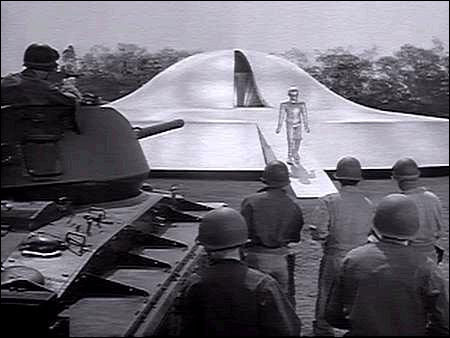
[above] In the film "The Day the Earth Stood Still," an alien visitor stopped every electrical apparatus all over the globe as a demonstration of his power. An EMP, although not effecting the entire world, would cause a similar catastrophe.

It is possible to shield electronic equipment from EMP radiation, but it is extremely difficult. The protected components must be completely enclosed in a copper shield. Even a small hole will allow the radiation to enter and any wires extending outside the shield will defeat the protection. For all practical purposes, this is not possible.

Air Force One, the President's jet, and certain other strategic aircraft have been equipped with special shields to reduce the effects of the radiation. Oddly, old radio equipment using vacuum tubes are less likely to be hurt by the radiation than transistor circuitry and many existing Russian aircraft still maintain these old systems for this reason.

[Above] Special Air Force E-4 being tested for EMP shielding.

Just one is enough

This threat is not imaginary. The House Armed Services Committee issued its warning to Congress on July 10, 2008 citing the fact that the Russians have already tested small yield EMP weapons of 300 kilotons at altitudes of 60, 150 and 300 kilometers and produced the effects described above at distances up to 600 kilometers from the test site. An actual weapon would be many times stronger.

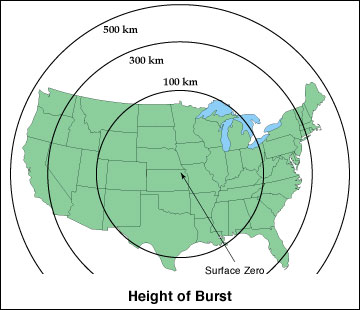
Areas of medium yield EMP destruction with a single burst over Kansas
at 100, 300 and 500 km.

The scientists describe three possible EMP effects, depending on the height of the detonation. Because the gamma rays travel in a line of sight path, the most dramatic effect comes from a high altitude blast. Here, the gamma rays can travel further and the Earth's magnetic field deflects the pulse back to the surface.

Such an attack could easily be launched from a submarine, just off the coast, and need not be accurate. The altitude and coordinates of detonation can vary widely and the effects will be just as lethal to the electronics. If several are launched, the chances of one reaching its optimum height is almost guaranteed. Once the EMP has been discharged, the circuitry of subsequent missile eletronics will be useless, leaving us vulnerable to more attacks.

The House Armed Services Committee confirmed that these weapons do not need to be accurately targeted to destroy our infrastructure. A medium size nuke, detonated from between 150 and 500 miles anywhere over Kansas, would be enough to destroy a hundred years of technological development. By comparison, the space shuttle and space station orbit about 110 to 150 miles above Earth, well below the optimal detonation of a potential EMP weapon.

An orbiting nuke could possibly already be poised, waiting to be used in a future conflict. If such a weapon is already up there, it is completely beyond our current capability to destroy it. Once it is detonated, our remaining electronic defense systems would be relatively useless. Checkmate.

But wait -- there's more!

Recently, scientists have developed a way to produce an EMP weapon without fissionable material. These non-nuclear devices are smaller than nuclear fueled pulse generators but their effect can be just as effective over a limited geographic area.

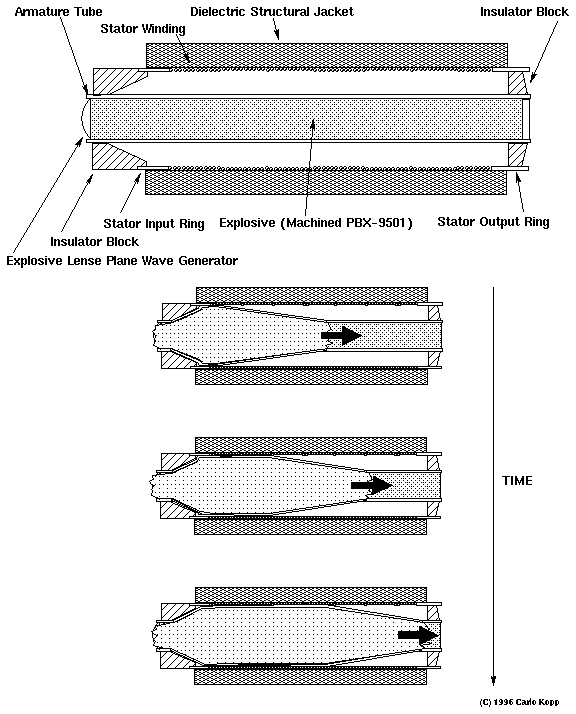
In the apparatus above, power is supplied by a bank of capacitors. These capacitors are similar to the system used to power a strobe flash. The ingition first charges the large coil, producing a magnetic field. Then an explosive charge begins at one end of the coil, shorting the coil by compressing it against the metallic shield. The effect changes the inductance of the coil, essentially shortening the field as the explosion advances down the tube.

The resulting electromagnetic pulse has a wide spectrum of wavelengths, capable of energizing metallic objects of varied lengths, from hundreds of feet to a few inches. All of the artificial "antennae" then become charged with enormous electrical currents which burn and render their components useless.

This type of non-nuclear apparatus is almost impossible to detect but is limited in scope and power by the size of the charging capacitors.

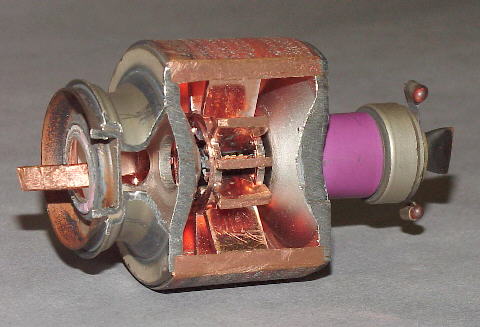
[above] Inside an industrial magnetron.

Some smaller devices could easily be made by terrorists. In fact, a simple search of the internet yields plans and secifications for constructing small EMP devices from readily available components such as the megatrons from industrial microwave ovens, rated at 800 to 1200 watts, and several automotive batteries. These devices are said to be able, with the addition of a parabolic reflector, to disable the electronics of a modern car or truck within 200 meters.

Commercially sold shock wave generators [right] are capable of producing focused acoustic or electromagnetic energy that can break up objects such as kidney stones and other similar materials. EMP generators can produce pulses of electromagnetic energy that can destroy the sensitive electronics in computers and microprocessors. Destabilized LCR circuits can produce multi megawatt pulses by using an explosive wire disruptive switch to achieve an effect similar to larger EMP devices.

The point here is not to make you go out and build an EMP weapon. It is to make you aware that the technology is very real and that we are currently extremely vulnerable to the effects of this type of weapon. Nations, like the US and Russia, have already developed these weapons on a scale capable of devastating our modern, technological dependent civilization.

Should you be paranoid? Well, I know some people who have stopped putting their money in banks and have started storing food and water. Collecting books on farming and gardening is another good idea. Some are even exercising more, getting ready for long walks along deserted highways and roads.

What will you do?

Thursday, January 22, 2009

Obama is sworn in for second time

Barack Obama has been sworn in as US president for the second time in two days, because one word was given out of order during Tuesday's ceremony.

The Chief Justice of the US Supreme Court, John Roberts, administered the oath again at the White House.

The decision to repeat the oath was taken out of an abundance of caution, an official said.

But Mr Obama joked: "We decided it was so much fun...." before adding: "We're going to do it very slowly."

In contrast to the first oath-taking, Mr Obama did not swear on a Bible and his wife Michelle was not at his side.

And instead of an audience of millions, only a few close aides saw the second attempt, with even journalists excluded from the Map Room of the White House.

Tuesday's stumble went largely unnoticed at the time.

In the oath, as set out in the US Constitution, the new incumbent swears to "faithfully execute the office of president of the United States".

But as Chief Justice Roberts read out the oath for Mr Obama to repeat, he moved the word "faithfully" to the end of the phrase.

Mr Obama, apparently noticing the error, hesitated. Mr Roberts repeated the phrase correctly, but Mr Obama went with the incorrect formula.

"We believe the oath of office was administered effectively and that the president was sworn in appropriately," said White House counsel Greg Craig.

"Out of the abundance of caution, because there was one word out of sequence, Chief Justice John Roberts will administer the oath a second time."

Two other presidents, Calvin Coolidge and Chester Arthur, have had to repeat the oath because of similar problems.

And Chief Justice William Taft introduced a new word into the oath when he swore in President Herbert Hoover in 1929, promising to "preserve, maintain and defend the Constitution", instead of "preserve, protect and defend".

Planning Agency Approves Homeland Security Complex

Washington Post Staff Writer
Friday, January 9, 2009; Page B01

After years of battling historic preservationists, the federal government won approval yesterday to build a massive headquarters for the Department of Homeland Security on a 176-acre hilltop site east of the Anacostia River.

The $3.4 billion headquarters would be one of the largest construction projects in the Washington area since the Pentagon was built in the 1940s. Advocates say it would generate economic activity in one of the city's poorer corners and provide a secure workplace for 14,000 Homeland Security employees scattered across the Washington area.

"This is an important step forward for Anacostia and for Washington," said John V. Cogbill III, chairman of the National Capital Planning Commission, which voted 9 to 1 to approve the master plan for the headquarters, to be built on the grounds of St. Elizabeths Hospital.

Historical preservationists have said the project would ruin a national landmark site with panoramic views of the District, where the first federal psychiatric institution was established in Southeast Washington in 1852. Some questioned whether a high-security facility tucked behind two layers of fencing would produce much of a payoff for the neighborhood.

"The DHS employees might as well be working on the moon for all their presence will benefit the city," testified David Garrison, a fellow at the Brookings Institution, who said that the personnel would largely commute from the suburbs.

The dissenting vote on the master plan came from a National Park Service representative, who warned that the development could endanger the site's historic landmark status.

If Congress provides funding, construction will begin next year and continue through 2016, according to the plan. Building the complex and renovating existing historical structures would create at least 26,000 jobs, officials said.

"The timing is optimal," said Del. Eleanor Holmes Norton (D-D.C.), who has championed the project. "Development has dried up in the city, and this is direct government-funded work."

Under the plan, most of the facility would be built on the vacant western campus of St. Elizabeths, property owned by the federal General Services Administration. One large building would be constructed on land leased from the District on the eastern campus, where the D.C. government is hoping to lure offices, restaurants and shops.

Residents of nearby neighborhoods have expressed mixed feelings about the complex. James Bunn, executive director of the Ward 8 Business Council, predicted that Homeland Security's migration would serve as a long-needed catalyst for new retail and housing in the Congress Heights community.

"Those 14,000 employees will need a place to live," he said. "And they'll need somewhere to eat. I can already see a coffee shop or a sit-down restaurant. It's a win-win situation for the ward."

But Linda Jackson, executive director of the East of the River Community Development Corp., questioned whether Homeland Security employees would leave their self-contained campus along Martin Luther King Jr. Avenue and frequent nearby businesses.

Wednesday, January 14, 2009

The Humiliation of America

Paul Craig Roberts
Infowars
January 14, 2009
“Early Friday morning the secretary of state was considering bringing the cease-fire resolution to a UNSC vote and we didn’t want her to vote for it,” Olmert said. “I said ‘get President Bush on the phone.’ They tried and told me he was in the middle of a lecture in Philadelphia. I said ‘I’m not interested, I need to speak to him now.’ He got down from the podium, went out and took the phone call.”
"Let me see if I understand this,” wrote a friend in response to news reports that Israeli Prime Minister Olmert ordered President Bush from the podium where he was giving a speech to receive Israel’s instructions about how the United States had to vote on the UN resolution. “On September 11th, President Bush is interrupted while reading a story to school children and told the World Trade Center had been hit–and he went on reading. Now, Olmert calls about a UN resolution when Bush is giving a speech and Bush leaves the stage to take the call. There exists no greater example of a master-servant relationship.”
Olmert gloated as he told Israelis how he had shamed US Secretary of State Condi Rice by preventing the American Secretary of State from supporting a resolution that she had helped to craft. Olmert proudly related how he had interrupted President Bush’s speech in order to give Bush his marching orders on the UN vote.
Israeli politicians have been bragging for decades about the control they exercise over the US government. In his final press conference, President Bush, deluded to the very end, said that the whole world respects America. In fact, when the world looks at America, what it sees is an Israeli colony.
Responding to mounting reports from the Red Cross and human rights organizations of Israel’s massive war crimes in Gaza, the United Nations Human Rights Council voted 33-1 on January 12 to condemn Israel for grave offenses against human rights.


On January 13, the London Times reported that Israelis have gathered on a hillside overlooking Gaza to enjoy the slaughter of Palestinians in what the Times calls “the ultimate spectator sport.”
It is American supplied F-16 fighter jets, helicopter gunships, missiles, and bombs that are destroying the civilian infrastructure of Gaza and murdering the Palestinians who have been packed into the tiny strip of land. What is happening to the Palestinians herded into the Gaza Ghetto is happening because of American money and weapons. It is just as much an attack by the United States as an attack by Israel. The US government is complicit in the war crimes.
Yet in his farewell press conference on January 12, Bush said that the world respects America for its compassion.
The compassion of bombing a UN school for girls?
The compassion of herding 100 Palestinians into one house and then shelling it?
The compassion of bombing hospitals and mosques?
The compassion of depriving 1.5 million Palestinians of food, medicine, and energy?
The compassion of violently overthrowing the democratically elected Hamas government?
The compassion of blowing up the infrastructure of one of the poorest and most deprived people on earth?
The compassion of abstaining from a Security Council vote condemning these actions?
And this is a repeat of what the Israelis and Americans did to Lebanon in 2006, what the Americans did to Iraqis for six years and are continuing to do to Afghans after seven years. And still hope to do to the Iranians and Syrians.
In 2002 I designated George W. Bush “the White House Moron.” If there ever was any doubt about this designation, Bush’s final press conference dispelled it.
Bush talked about connecting the dots, but Bush has failed to connect any dots for eight solid years. “Our” president was a puppet for a cabal led by Dick Cheney and a handful of Jewish neoconservatives, who took control of the Pentagon, the State Department, the National Security Council, the CIA, and “Homeland Security.” From these power positions, the neocon cabal used lies and deception to invade Afghanistan and Iraq, pointless wars that have cost Americans $3 trillion, while millions of Americans lose their jobs, their pensions, and their access to health care.
“These obviously very difficult economic times,” Bush said in his press conference, “started before my presidency.”
Bush has plenty of liberal company in failing to connect a $3 trillion dollar war with hard times. The Center on Budget and Policy Priorities blames Bush’s tax cut, not the wars, for “the fiscal deterioration.”
Bush told the White House Press Corps, a useless collection of non-journalists, that the two mistakes of his invasion of Iraq were: (1) Putting up the “mission accomplished” banner on the aircraft carrier, which, he said, “sent the wrong message,” and (2) the absence of the alleged weapons of mass destruction that he used to justify the invasion.
Although Bush now admits that there were not any such weapons in Iraq, Bush said that the invasion was still the right thing to do.
The deaths of 1.25 million Iraqis, the displacement of 4 million Iraqis, and the destruction of a country’s infrastructure and economy are merely the collateral damage associated with “bringing freedom and democracy” to the Middle East.
Unless George W. Bush is the best actor in human history, he truly believes what he told the White House Press Corps.
What Bush did not explain is how America is respected when its people put a moron in charge for eight years.

Thursday, January 8, 2009

Martial Law, the Financial Bailout, and War

Prof. Peter Dale Scott
Global Research
January 8, 2009
Paulson’s Financial Bailout
It is becoming clear that the bailout measures of late 2008 may have consequences at least as grave for an open society as the response to 9/11 in 2001. Many members of Congress felt coerced into voting against their inclinations, and the normal procedures for orderly consideration of a bill were dispensed with.


Brussels


  It is clear that there has been a sustained move in the direction of martial law preparations, a trend that has been as continuous as it has been unheralded.


The excuse for bypassing normal legislative procedures was the existence of an emergency. But one of the most reprehensible features of the legislation, that it allowed Treasury Secretary Henry Paulson to permit bailed-out institutions to use public money for exorbitant salaries and bonuses, was inserted by Paulson after the immediate crisis had passed.
According to Congressman Peter Welch (D-Vermont) the bailout bill originally called for a cap on executive salaries, but Paulson changed the requirement at the last minute. Welch and other members of Congress were enraged by “news that banks getting taxpayer-funded bailouts are still paying exorbitant salaries, bonuses, and other benefits.”1 In addition, as AP reported in October, “Sen. Charles Schumer, D-N.Y. questioned allowing banks that accept bailout bucks to continue paying dividends on their common stock. `There are far better uses of taxpayer dollars than continuing dividend payments to shareholders,’ he said.”2
Even more reprehensible is the fact that since the bailouts, Paulson and the Treasury Department have refused to provide details of the Troubled Assets Relief Program spending of hundreds of billions of dollars, while the New York Federal Reserve has refused to provide information about its own bail-out (using government-backed loans) that amounts to trillions. This lack of transparency has been challenged by Fox TV in a FOIA suit against the Treasury Department, and a suit by Bloomberg News against the Fed.3
The financial bailout legislation of September 2008 was only passed after members of both Congressional houses were warned that failure to act would threaten civil unrest and the imposition of martial law.
U.S. Sen. James Inhofe, R-Okla., and U.S. Rep. Brad Sherman, D-Calif., both said U.S. Treasury Secretary Henry Paulson brought up a worst-case scenario as he pushed for the Wall Street bailout in September. Paulson, former Goldman Sachs CEO, said that might even require a declaration of martial law, the two noted.4
Here are the original remarks by Senator Inhofe:
Speaking on Tulsa Oklahoma’s 1170 KFAQ, when asked who was behind threats of martial law and civil unrest if the bailout bill failed, Senator James Inhofe named Treasury Secretary Henry Paulson as the source. “Somebody in D.C. was feeding you guys quite a story prior to the bailout, a story that if we didn’t do this we were going to see something on the scale of the depression, there were people talking about martial law being instituted, civil unrest….who was feeding you guys this stuff?,” asked host Pat Campbell. “That’s Henry Paulson,” responded Inhofe, “We had a conference call early on, it was on a Friday I think – a week and half before the vote on Oct. 1. So it would have been the middle … what was it – the 19th of September, we had a conference call. In this conference call – and I guess there’s no reason for me not to repeat what he said, but he said – he painted this picture you just described. He said, ‘This is serious. This is the most serious thing that we faced.’”5
Rep. Brad Sherman (D-CA 27th District) reported the same threat on the Congressional floor (Rep. Sherman later downplayed his remarks slightly on the Alex Jones show):
“The only way they can pass this bill is by creating a panic atmosphere…. Many of us were told that the sky would fall…. A few of us were even told that there would be martial law in America if we voted no. That’s what I call fear-mongering, unjustified, proven wrong.”6
So it is clear that threats of martial law were used to get this reprehensible bailout legislation passed. It also seems clear that Congress was told of a threat of martial law, not itself threatened. It is still entirely appropriate to link such talk to the Army’s rapid moves to redefine its role as one of controlling the American people, not just protecting them. In a constitutional polity based on balance of powers, we see the emergence of a radical new military power that is as yet completely unbalanced.
The Army’s New Role in 2001: Not Protecting American Society, but Controlling It
This new role for the Army is not wholly unprecedented. The U.S. military had been training troops and police in "civil disturbance planning" for the last three decades. The master plan, Department of Defense Civil Disturbance Plan 55-2, or "Operation Garden Plot," was developed in 1968 in response to the major protests and disturbances of the 1960s.
But on January 19, 2001, on the last day of the Clinton administration, the U.S. Army promulgated a new and permanent Continuity of Operations (COOP) Program. It encapsulated its difference from the preceding, externally-oriented Army Survival, Recovery, and Reconstitution System (ASRRS) as follows:
a. In 1985, the Chief of Staff of the Army established the Army Survival, Recovery, and Reconstitution System (ASRRS) to ensure the continuity of essential Army missions and functions.
ASRRS doctrine was focused primarily on a response to the worst case 1980’s threat of a massive nuclear laydown on CONUS as a result of a confrontation with the Soviet Union.
b. The end of the Cold War and the breakup of the former Soviet Union significantly reduced the probability of a major nuclear attack on CONUS but the probability of other threats has increased. Army organizations must be prepared for any contingency with a potential for interruption of normal operations.
To emphasize that Army continuity of operations planning is now focused on the full all-hazards threat spectrum, the name "ASRRS" has been replaced by the more generic title “Continuity of Operations (COOP) Program.”7
This document embodied the secret Continuity of Operations (COG) planning conducted secretly by Rumsfeld, Cheney, and others through the 1980s and 1990s.8 This planning was initially for continuity measures in the event of a nuclear attack, but soon called for suspension of the Constitution, not just “after a nuclear war” but for any “national security emergency.” This was defined in Reagan’s Executive Order 12656 of November 18, 1988 as “any occurrence, including natural disaster, military attack, technological emergency, or other emergency, that seriously degrades or seriously threatens the national security of the United States.” The effect was to impose on domestic civil society the extreme measures once planned for a response to a nuclear attack from abroad.9
In like fashion ARR 500-3 Regulation clarified that it was a plan for “the execution of mission-essential functions without unacceptable interruption during a national security or domestic emergency.”
Donald Rumsfeld, who as a private citizen had helped author the COG planning, promptly signed and implemented the revised ARR 500-3. Eight months later, on 9/11, Cheney and Rumsfeld implemented COG, a significant event of which we still know next to nothing. What we do know is that plans began almost immediately – as foreseen by COG planning the 1980s — to implement warrantless surveillance and detention of large numbers of civilians, and that in January 2002 the Pentagon submitted a proposal for deploying troops on American streets.10
Then in April 2002, Defense officials implemented a plan for domestic U.S. military operations by creating a new U.S. Northern Command (CINC-NORTHCOM) for the continental United States.11 In short, what were being implemented were the most prominent features of the COG planning which Oliver North had worked on in the 1980s.
Deep Events and Changes of Party in the White House
Like so many other significant steps since World War Two towards a military-industrial state, the Army’s Regulation 500-3 surfaced in the last days of a departing administration (in this case the very last day). It is worth noticing that, ever since the 1950s, dubious events–of the unpublic variety I have called deep events–have marked the last months before a change of party in the White House. These deep events have tended to a) constrain incoming presidents, if the incomer is a Democrat, or alternatively b) to pave the way for the incomer, if he is a Republican.
Consider, in the first category, the following (when a Republican was succeeded by a Democrat):
* In December 1960 the CIA secured approval for the Bay of Pigs invasion of Cuba, and escalated events in Laos into a crisis for which the Joint Chiefs proposed sending 60,000 troops. These events profoundly affected President Kennedy’s posture towards Cuba and Indochina.
* In 1976 CIA Director George H.W. Bush installed an outside Team B intelligence unit to enlarge drastically estimates of the Soviet threat to the United States, eventually frustrating and reversing presidential candidate Jimmy Carter’s campaign pledge to cut the U.S. defense budget.12
Equally important were events in the second category (when a Democrat was succeeded by a Republican):
* In late 1968 Kissinger, while advising the Johnson administration, gave secret information to the Nixon campaign that helped Nixon to obstruct the peace agreement in Vietnam that was about to be negotiated at the peace talks then taking place in Paris. (According to Seymour Hersh,“The Nixon campaign, alerted by Kissinger to the impending success of the peace talks, was able to get a series of messages to the Thieu government” in Saigon. making it clear that a Nixon presidency would offer a better deal. This was a major factor in securing the defeat of Democratic candidate Hubert Humphrey.13 Kissinger was not the kind of person to have betrayed his president on his own personal initiative. At the time Nixon’s campaign manager, John Mitchell (one of the very few in on the secret), told Hersh that “I thought Henry [Kissinger] was doing it because Nelson [Rockefeller] wanted him to. Nelson asked Henry to help and he did.”14
* In 1980 the so-called October Surprise, with the help of people inside CIA, helped ensure that the Americans held hostage in Iran would not be returned before the inauguration of Reagan. This was a major factor in securing the defeat of incumbent Jimmy Carter.15 Once again, the influence of the Rockefellers can be discerned. A CIA officer later reported hearing Joseph V. Reed, an aide to David Rockefeller, comment in 1981 to William Casey, the newly installed CIA Director, about their joint success in disrupting Carter’s plans to bring home the hostages.16
Both the financial bailout, extorted from Congress and the escalated preparations for martial law can be seen as transitional events of the first category. Whatever the explanations for their timing, they will constrain Obama’s freedom to make his own policies. I fear moreover they may have the consequence of easing this country into unforeseen escalations of the Afghan war.
The Intensive Quiet Preparations for Martial Law
Let us deal first with the preparations for martial law. On September 30, 2008, the Army Times announced the redeployment of an active Brigade Army Team from Iraq to America, in a new mission that “may become a permanent part of the active Army”:
The 3rd Infantry Division’s 1st Brigade Combat Team has spent 35 of the last 60 months in Iraq patrolling in full battle rattle, helping restore essential services and escorting supply convoys.
Now they’re training for the same mission — with a twist — at home.
Beginning Oct. 1 for 12 months, the 1st BCT will be under the day-to-day control of U.S. Army North, the Army service component of Northern Command, as an on-call federal response force for natural or manmade emergencies and disasters, including terrorist attacks. . . . After 1st BCT finishes its dwell-time mission, expectations are that another, as yet unnamed, active-duty brigade will take over and that the mission will be a permanent one. . . .They may be called upon to help with civil unrest and crowd control.17
This announcement followed by two weeks the talk of civil unrest and martial law that was used to panic the Congress into passing Paulson’s bailout legislation. Not only that, the two unprecedented events mirror each other: the bailout debate anticipated civil unrest and martial law, while the announced positioning of an active Brigade Combat Team on U.S. soil anticipated civil unrest (such as might result from the bailout legislation).
Then on December 17, 2008, US Northern Command chief General Renuart announced that “the US military plans to mobilize thousands of troops to protect Washington against potential terrorist attack during the inauguration of president-elect Barack Obama.”18
The US Army War College has also raised the possibility of the U.S. Army being used to control civil unrest, according to the Phoenix Business Journal:
A new report by the U.S. Army War College talks about the possibility of Pentagon resources and troops being used should the economic crisis lead to civil unrest, such as protests against businesses and government or runs on beleaguered banks.
“Widespread civil violence inside the United States would force the defense establishment to reorient priorities in extremis to defend basic domestic order and human security,” said the War College report.
The study says economic collapse, terrorism and loss of legal order are among possible domestic shocks that might require military action within the U.S.19
It is clear that there has been a sustained move in the direction of martial law preparations, a trend that has been as continuous as it has been unheralded. Senator Leahy was thus right to draw our attention to it back on September 29, 2006, in his objections to the final form of the Fiscal Year 2007 National Defense Authorization Act, which gave the president increased power to call up the National Guard for law enforcement:
It . . . should concern us all that the Conference agreement includes language that subverts solid, longstanding posse comitatus statutes that limit the military’s involvement in law enforcement, thereby making it easier for the President to declare martial law. There is good reason for the constructive friction in existing law when it comes to martial law declarations.20
This quiet agglomeration of military power has not “just growed,” like Topsy, through inadvertence. It shows sustained intention, even if no one has made a public case for it.
How the Bush Administration Protected Predatory Lending and Let the Financial Crisis Grow
Let us now consider the financial crisis and the panic bailout. No one should think that the crisis was unforeseen. Back in February Eliot Spitzer, in one of his last acts as governor of New York, warned about the impending crisis created by predatory lending, and reveled that the Bush Administration was blocking state efforts to deal with it. His extraordinary warning, in the Washington Post, is worth quoting at some length:
Several years ago, state attorneys general and others involved in consumer protection began to notice a marked increase in a range of predatory lending practices by mortgage lenders. …
Even though predatory lending was becoming a national problem, the Bush administration looked the other way and did nothing to protect American homeowners. In fact, the government chose instead to align itself with the banks that were victimizing consumers. . . . Several state legislatures, including New York’s, enacted laws aimed at curbing such practices. . . .Not only did the Bush administration do nothing to protect consumers, it embarked on an aggressive and unprecedented campaign to prevent states from protecting their residents from the very problems to which the federal government was turning a blind eye.

Let me explain: The administration accomplished this feat through an obscure federal [Treasury] agency called the Office of the Comptroller of the Currency (OCC). The OCC has been in existence since the Civil War. Its mission is to ensure the fiscal soundness of national banks. For 140 years, the OCC examined the books of national banks to make sure they were balanced, an important but uncontroversial function. But a few years ago, for the first time in its history, the OCC was used as a tool against consumers.
In 2003, during the height of the predatory lending crisis, the OCC invoked a clause from the 1863 National Bank Act to issue formal opinions preempting all state predatory lending laws, thereby rendering them inoperative. The OCC also promulgated new rules that prevented states from enforcing any of their own consumer protection laws against national banks. The federal government’s actions were so egregious and so unprecedented that all 50 state attorneys general, and all 50 state banking superintendents, actively fought the new rules.
But the unanimous opposition of the 50 states did not deter, or even slow, the Bush administration in its goal of protecting the banks. In fact, when my office opened an investigation of possible discrimination in mortgage lending by a number of banks, the OCC filed a federal lawsuit to stop the investigation.21
Eliot Spitzer submitted his Op Ed to the Washington Post on February 13. If it had an impact, it was not the one Spitzer had hoped for. On March 10 the New York Times broke the story of Spitzer’s encounter with a prostitute. According to a later Times story, “on Feb. 13 [the day Spitzer’s Op Ed went up on the Washington Post website] federal agents staked out his hotel in Washington.”22
It is remarkable that the Mainstream Media found Spitzer’s private life to be big news, but not his charges that Paulson’s Treasury was prolonging the financial crisis, or the relation of these charges to Spitzer’s exposure. As a weblog commented,
The US news media failed to draw the obvious connection between the bizarre federal law enforcement investigation and leak campaign about the private life of New York Governor Spitzer and Spitzer’s all out attack on the Bush administration for its collusion with predatory lenders.
While the international credit system grinds to a halt because of a superabundance of bad mortgage loans made in the US, the news media failed to cover the details of Spitzer’s public charges against the White House.
Yet when salacious details were leaked about alleged details of Spitzer’s private life, they took that information and made it the front page news for days.23
After Spitzer’s Op Ed was published, according to Greg Palast, the Federal Reserve, “for the first time in its history, loaned a selected coterie of banks one-fifth of a trillion dollars to guarantee these banks’ mortgage-backed junk bonds. The deluge of public loot was an eye-popping windfall to the very banking predators who have brought two million families to the brink of foreclosure.”24
What are we to make of Spitzer’s charge that the Bush administration interfered to preempt state laws against predatory lending, and of the fact that the mainstream media did not report that? A petty motive for the OCC’s behavior in 2003 might have been to allow the housing bubble to continue through 2003 and 2004, thus facilitating Bush’s re-election. But the persistence of Treasury obstruction thereafter, despite the unanimous opposition of all fifty states, and the continuing silence of the media about this disagreement, suggest that some broader policy intention may have been at stake.
One is struck by the similarities with the Savings and Loan scandal which was allowed to continue through the Reagan 1980s, long after it became apparent that deliberate bankruptcy was being used by unscrupulous profiteers to amass illegal fortunes at what was ultimately public expense.25
In the same way, the long drawn-out housing bubble of the current Bush decade, and particularly the derivative bubble that was floated upon it, allowed the Bush administration to help offset the trillion-dollar-plus cost of its Iraq misadventure,26 by creating spurious securities that sold for hundreds of billions, not just in the United States, but through the rest of the world.
In the long run, this was not a sustainable source of wealth for America’s financial class, which is now suffering like everyone else from the consequent recession. But in the short run, the financial crisis and bailout made it possible for Bush to wage a costly war without experiencing the kind of debilitating inflation that was brought on by America’s Vietnam War.

The trillion dollar meltdown,27 in other words, can be rationalized as having helped finance the Iraq War. When we turn to the martial law preparations, however, they are being made in anticipation of civil unrest in the future. Why such intense preparation for this?
The obvious answer of course is memory of the rioting that occurred in San Francisco and elsewhere during the great depression of the 1930s. Indeed that thought may be uppermost among those who recently arranged for the redeployment of a Brigade Combat Team from Iraq to America. But the planning for martial law in America dates back almost three decades, from the days when Reagan appointed Rumsfeld, Cheney and others to plan secretly for what was misleadingly called Continuity [i.e., Change] of Government. Concern about the 2008 recession cannot have been on their minds then, or on those who introduced the Army’s “Continuity of Operations (COOP) Program” on January 19, 2001. Instead the “full all-hazards threat spectrum” envisaged in that document was clearly ancillary to the doctrine of “full-spectrum dominance” that had been articulated in the Joint Chiefs of Staff blueprint, Joint Vision 2020, endorsed eight months earlier on May 30, 2000.28
The interest of Cheney and Rumsfeld in COG planning, including planning for martial law, also envisaged full spectrum dominance. This is made clear by their simultaneous engagement in the 1990s in the public Project for the New American Century (PNAC). PNAC’s goals were stated very explicitly in their document Rebuilding America’s Defenses: to increase defense spending so as to establish America’s military presence throughout the world as an unchallengeable power. This would entail permanent U.S. forces in central as well as east Asia, even after the disappearance[jam1] of Saddam Hussein.29
In short PNAC’s program was a blueprint for permanent overseas American empire, a project they recognized would not be easily accepted by an American democracy. Their call frankly acknowledged that it would be difficult to gain support for their projected increase in defense spending to “a minimum level of 3.5 to 3.8 percent of gross domestic product, adding $15 billion to $20 billion to total defense spending annually.” “The process of transformation,” the document admitted, “is likely to be a long one, absent some catastrophic and catalyzing event—like a new Pearl Harbor.”30
There is of course every reason to hope that the disastrous era of Rumsfeld and Cheney is about to end, with the election of Barack Obama. Obama has made it clear that he will pursue a foreign policy dedicated to diplomacy and multilateralism. In this spirit he has declared his willingness to talk to Iran without preconditions.
But Obama’s stated reason for disengagement from Iraq – “The scale of our deployments in Iraq continues to set back our ability to finish the fight in Afghanistan”31 – is very ominous. Few serious students of the Afghan scene believe that America can “finish the fight in Afghanistan,” any more successfully than could the Russians or British before them. The U.S. position there is visibly deteriorating, while the U.S. strategy of cross-border attacks is having the effect of destabilizing Pakistan as well. The U.S.-backed Karzai regime has so little control over the countryside that Kabul itself is now coming under rocket attack. Experts on the scene agree that any effort to “finish” will be a long-term proposition requiring at a minimum a vastly escalated commitment of U.S. troops.32
One cannot predict the future, but one can examine the past. For thirty years I have been writing about the persistence in America of a war mentality that, time after time, trumps reasonable policies of negotiation, and leads us further into armed conflict. This dominant mindset is not restricted to any single agency or cabal, but is rather the likely outcome of on-going tensions between hawks and doves in the internal politics of Washington.
If a container of rocks and gravel is shaken vigorously, the probability is that the gravel will gravitate towards the bottom, leaving the largest rocks at the top. There is an analogous probability that, in an on-going debate over engaging or withdrawing from a difficult military contest, the forces for engagement will come out on top, regardless of circumstances. Available military power tends to be used, and one of the most remarkable features of history since 1945 is that this tendency has not so far repeated itself with atomic weapons.
Let me explain this metaphor in more concrete detail. Progressive societies (in this era usually democracies) tend to expand their presence beyond their geographic boundaries. This expanded presence calls for new institutions, usually (like the CIA) free from democratic accountability. This accretion of unaccountable power, in what I have elsewhere called the deep state, disrupts the public state’s system of checks and balances which is the underpinning of sane, deliberative policy.
We might expect of progressive democracies that they would evolve towards more and more rational foreign policies. But because of the dialectic just described, what we see is the exact opposite – evolution towards foolish and sometimes disastrous engagements. When Britain became more democratic in the late 19th Century, it also initiated the Boer War, a war very suited to the private imperial needs of Cecil Rhodes, but irrelevant if not deleterious to the interests of the British people.33 Hitler’s dreams of a Third Reich, entailing a doomed repeat of Napoleon’s venture into the heart of Russia, suited the needs of the German industrialists who had financed the Nazis; but from the outset sane heads of the German military staff could foresee the coming disaster.
For over a half century now, beginning with Vietnam, unaccountable forces have been maneuvering America into unsustainable adventures on the Asian mainland. We now know that Kennedy did not intend ever to commit U.S. combat troops to Vietnam.34 But the fatal planning to expand the Vietnam War north of the 17th parallel was authorized in the last week of his aborted presidency, probably without his being aware.35 When elected, Jimmy Carter was determined to reduce the size and frequency of CIA covert operations.36 Yet his national security advisor, Zbigniew Brzezinski, initiated maneuvers in Afghanistan that led to the largest CIA covert operation (and in my view, one of the most deleterious) of all time.37

Pages: 1 2

Thursday, January 1, 2009

Would They Be Planning to Use Troops Against Americans If They WEREN’T Stealing Our Money?

George Washington’s Blog
Wednesday, Dec 31, 2008
Political science professor at the University of Texas at El Paso Charles Boehmer points out that “The military was not called out during the Great Depression….”
So why is the military planning on how to crush civil protest in regards to the current economic crisis (see this, this, this, this, this and this)?
Is it because the theft - via “bailouts” and other hanky-panky by Treasury, the Fed and others - of hard-earned taxpayer wealth is
so obvious that the military expects Americans to revolt?
The other potential explanation is that the military has been told that this financial crisis could be much, much worse than the Great Depression.
So which is it? The obviousness of the theft or the severity of the crisis?
My guess . . . both.

Obama Seeks Bipartisanship; Republican National Committee Declares War (Brent Budowsky)

"Barack Obama will probably be tested by the Russians, but he is definitely being tested right now by the Republicans. While Obama seeks a bipartisan stimulus and decides whether to investigate issues such as torture and domestic spying, the Republican National Committee (RNC) discusses a sick and demented CD about "Barack the Magic Negro" and prepares to formally attack Bush, Republican leaders in Congress, Democratic leaders and Obama as socialists and oppose any economic aid to companies and seek to dramatically cut back any economic recovery program for the nation."

Will the RNC attack everyone in a radical, extreme and irresponsible effort to kill any significant economic program, attack everyone as socialists and intimidate Republican leaders in Congress into joining their ill-fated mission of economic destruction?"

My view is that torture fundamentally violates historic American notions of law and clear rules of international law and that what was done violates cardinal American principles that were honored from George Washington through Bill Clinton and accepted by every president and Congress until George W. Bush. The same is true for eavesdropping on a massive scale, in clear violation of the FISA law, without even any proof that our security was enhanced. "

Wednesday, December 24, 2008

Ron Paul on the Martial Law

US ARMY READY IF THE DOWNTURN GETS OUT OF HAND

ARE you afraid that the eco nomic downturn could get out of hand? I mean, really out of hand?
Well, don't worry.
The US Army War College is on the case - ready to handle "unforeseen economic collapse" and the "rapid dissolution of public order in all or significant parts of the US."
And you thought we were just dealing with a recession!
In a report published Nov. 4 - just in time for the holiday season - the War College's Strategic Studies Institute posited a number of shocks that the country should be prepared for, including unrest caused by the economy's failure.
The report has a snappy title, "Known Unknowns: Unconventional 'Strategic Shocks' in Defense Strategy Development," and was written by Nathan Freier, a visiting professor at the college. The foreword was written by Col. John A. Kardos, director of the Peacekeeping and Stability Operations Institute.
Freier lists a number of possible things we should worry about - because we probably don't have enough of our own - including run-of-the-mill terrorism and the fact that China and Russia could align against us politically and economically.
"Some of the most plausible defense-relevant strategic shocks remain low-probability events," Freier soft-pedals before going on to scare the hell out of us.
The War College says "widespread civil violence inside the US would force the defense establishment to reorient priorities in extremis to defend basic domestic order and human security."
Among things Freier wants us to worry about are "deliberate employment of weapons of mass destruction. . . unforeseen economic collapse, loss of functioning political and legal order, purposeful domestic resistance or insurgency and catastrophic natural and human disasters."
Oh, and by the way, have a Merry Christmas!
*
I have a confession to make: I am a member of the United Auto Workers union.
It's not a "confession" in the sense that there is anything wrong with it.
Here's how my membership happened.
I teach a course at New York University. And a couple of years ago, the United Auto Workers unionized the university's adjunct professors, or teachers who are happy to be underpaid because we earn a living elsewhere.
The union apparently thought untenured teachers were a better bet than people who make cars. And, guess what, it was right.
Anyhow, after being threatened by the union with dismissal from NYU if I didn't join, I reluctantly began paying dues. And I completely forgot about it until the matter came up at a Christmas party at the university last week.
So, you are probably wondering if I think my brother union members should give concessions to keep GM, Ford and Chrysler alive.
I'll have to get back to you on that after I check with headquarters.
*
So, you are losing sleep because of the financial markets.
Maybe it's because of your mattress.
A research firm in Cleveland says the economy and financial stress are affecting sales of bedding.
Longbow Research reports that 87 percent of retail ers it surveyed said mattress sales are declining.
Longbow says that the sales decline worsened in Octo ber and November.
Maybe people are afraid to change mat tresses because that's where all their money is hidden.
john.crudele@nypost.com

Sunday, December 21, 2008

Bailiffs get power to use force on debtors

The government has been accused of trampling on individual liberties by proposing wide-ranging new powers for bailiffs to break into homes and to use “reasonable force” against householders who try to protect their valuables.

Under the regulations, bailiffs for private firms would for the first time be given permission to restrain or pin down householders. They would also be able to force their way into homes to seize property to pay off debts, such as unpaid credit card bills and loans.

The government, which wants to crack down on people who evade debts, says the new powers would be overseen by a robust industry watchdog. However, the laws are being criticised as the latest erosion of the rights of the householder in his own home.

“These laws strip away tried and tested protections that make a person’s home his castle, and which have stood for centuries,” said Paul Nicolson, chairman of the Zacchaeus 2000 Trust, a London-based welfare charity. “They could clearly lead to violent confrontations and undermine fundamental liberties.”

Bailiffs have for hundreds of years been denied powers to break into homes for civil debt or to use force against debtors, except in self-defence. In a famous declaration, William Pitt the Elder, the 18th-century prime minister, said: “The poorest man may in his cottage bid defiance to all the forces of the crown.” Ministers have now proposed bailiffs be given powers to physically remove debtors who try to defend their property, for example by draping themselves over a car or blocking the door of their home. Lord Bach, a junior justice minister, has assured the House of Lords that any new powers will be implemented only after a consultation and will not be used to search debtors’ pockets or to remove jewellery.

It emerged last week that Her Majesty’s Courts Service has already handed out guidance to privately employed bailiffs, pointing out that under legislation passed in 2004 they can already break down doors as a last resort to collect court fines.

Some restraint should be exercised, according to the “search and entry powers” guidelines. “If a person locks himself in their home, it might be reasonable to break open the door, but probably not to smash a hole in the wall,” it advises.

Details of the new guidelines were obtained under freedom of information laws. They say homes should not be broken into when nobody is in. Reasonable grounds for breaking down the door include the “movement of a curtain”, a radio being heard or a figure being spotted inside which “may be the offender”.

It is claimed these powers are already abused. In one case, an 89-year-old grandmother returned home to find a bailiff sitting in her chair having drawn up a list of her possessions. He was pursuing a parking fine owed by her son, who did not even live at the address.

Saturday, December 20, 2008

Northcom Chief Vows to Address Worries About New Homeland Unit

A senior military official pledged Wednesday to address congressional concerns about a new homeland emergency response task force that is designed to respond to a chemical, biological or nuclear attack.
Air Force Gen. Victor E Renuart Jr., commander of U.S. Northern Command (Northcom), also told reporters that the new force, which will eventually total 20,000 personnel, will not require new funding right now and is not meant to authorize the federal government to enforce martial law.
Last week, Rep. John P. Murtha , D-Pa., the chairman of the House Appropriations Defense Subcommittee, complained that Congress had not been properly briefed on the new initiative, complicating its job as steward of the defense budget.
Renuart said that he planned to meet with Murtha in the coming weeks to discuss the program. “There have been some misunderstandings on the part of some in Congress on what this force is designed to do,” he said.
He said the unit, which is called the Chemical, Biological, Radiological, Nuclear, and Explosive Consequence Management Response Force (CCMRF), will not require significant new funding from Congress.
The new task force has come under fire from groups such as the American Civil Liberties Union that are concerned the move furthers the militarization of the homeland security mission. Critics also say the move could violate the Posse Comitatus Act of 1878, which aims to prohibit the federal government from using the armed forces in a domestic law enforcement capacity without congressional approval.
Renuart said the Pentagon does maintain a capability to impose order following a domestic crisis if law enforcement and national guard security efforts fail. But he added that he did not anticipate that scenario and it is not the mission of the new force.
“It is not a force designed to go in and enforce laws. The national guard is empowered to do that through the states,” said Renuart, “This force is designed to go and render assistance and aid, as opposed to create security.”

Comments on this Article:

  1. Rick in Toronto December 20, 2008 9:25 PM
    ...ah but lets not forget that the National Guard has just been placed under military command...so the U.S. military will in fact now be in a position to enforce laws on U.S. domestic territory. Be scared - very scared.
  2. Jiggs December 20, 2008 9:50 PM
    "It is not a force designed to go in and enforce laws... As the economy tanks there will be civil unrest... these troops will be used to impose the next level of martial law upon the People... FISA - Spying on Americans Patriot Act - Warrentless search and seizures Military Commisions Act - Off to prison with no Habeus Corpus And now homeland security troops to be used against the People. We are in an escalating police state. www dot infowars dot com
  3. Tim December 20, 2008 10:34 PM
    Renuart is lying through his teeth. Secretary of Defense Gates is running a plan to merge the National Guard with the Regular Army and they will be under the control of DOD, rendering the Governors useless. It is VERY IMPORTANT not to be myopic. People need to look at everything that is going on in this government and military industrial complex. This way you can "connect the dots" and catch these people in outright lies. Thanks to Alex Jones' INFOWARS.COM website I was able to take the Gates info and determine that the Northcom Chief is part of the psyops. Quoting a true patriot Luke Rudkowski, "The New World Order is going down! CFR, Council on Foreign Relations, you will never get your new world order. National Sovreignty will prevail !!!!!!!!!!!!!!!!!!!!!!!!!!!!!!!!!!!!!!!!!!!!!!!!!"

Ron Paul: Fear Based Bailouts Constitute Economic Terrorism

Congressman warns that auto-bailout could lead directly to fascism in America
Steve Watson
Infowars.net
December 19, 2008
Texas Congressman Ron Paul has hit out at US monetary policy, warning that fear based politics are being used to promote the bailout culture in the same way they were used to sell the Iraq war.
"Governments that want to take over, undermine our liberties and gain more power always use the fear factor. They did this leading up to the war in Iraq, they do it on foreign policy, now they’re doing it on monetary, economic and financial problems." Paul told the nationally syndicated Alex Jones show Wednesday.
"They do that all the time, that is their technique, always to build a tremendous fear in the hearts of the people. Terrorize the people and say that ‘we are your saviors and we’re the only ones that can take care of it’." The Congressman stated.
Paul pointed out that the use of the fear factor was never more evident than in the run up to the passage of the $750 billion bailout bill earlier this year when it emerged that representatives had been threatened with an economic crash and physical martial law in America.
When asked if this constituted economic terrorism, Paul replied "Of course it is, and those responsible should be held accountable."
The Congressman also warned that the bailout of the auto industry could have dire consequences.
"It is extremely dangerous because although we have been creeping in that direction, this is an endorsement of nationalization. If they keep token ownership with the corporations, which they probably will, then it’s called fascism." Paul said. 
"I think everybody knows we’re in a crisis now and they have now gotten to the point where they don’t trust the government, which is healthy." The Congressman told listeners.
"A lot of people are begging and pleading and they’re lining up. But the average guy outside of Washington, especially so many of the young people are realizing that this has all been a hoax and this is the time to really expose that hoax."
"We have a real opportunity to direct attention to the real culprit and that is those who control the monetary system. Those who counterfeit our money and cause the financial bubbles and then recessions, and now are working real hard on a depression." Paul continued.
"The only thing that can counteract this is a different philosophy. A convincing argument that free markets, sound money and no Federal Reserve and limited taxes, the things that made America great."
"The system that they are trying to patch together right now will not work. We don’t need more regulatory agencies, all we need is the enforcement of fraud laws." Paul concluded.
Listen to the full interview below:
 

Thursday, December 18, 2008

New Rapid-Response Forces to Bolster Homeland Defense Mission

Family Security Matters
Gerry J. Gilmore, American Forces Press Service
December 18, 2008
Pentagon officials have established a new rapid-response joint task force and plan to create two more in coming years to bolster assistance to civil authorities following potential chemical, biological or nuclear attacks or natural disasters, a senior U.S. official said here yesterday.
The new units will team with other federal agencies in support of local responders following chemical, biological or nuclear terror attacks on the homeland or during natural disasters, Paul McHale, assistant secretary of defense for homeland defense and Americas’ security affairs, told American Forces Press Service and Pentagon Channel reporters.
The establishment of the new units “builds upon a decade of improving [Defense Department] capabilities to deal with a domestic terrorist attack involving a weapon of mass destruction,” McHale said.
The first new 4,700-member task force was assigned to a component of U.S. Northern Command on Oct. 1, McHale said. The new unit, he said, is built around a core of active-duty soldiers from the U.S. Army 3rd Infantry Division’s 1st Brigade Combat Team based at Fort Stewart, Ga. This task force, he said, falls under the control of Northcom’s Joint Force Land Component Command, U.S. Army North, in San Antonio.

Plans are to stand up the other two new joint task forces in 2010 and 2011, respectively, McHale said. These units, he said, mostly will comprise reserve component personnel from all the military services.
Each task force will be capable of performing tasks such as medical response, decontamination, technical rescue, patient evacuation, and communications and logistics support, to include air and land transportation assets for transport of supplies, people and equipment, according to U.S. Army North documents.
The task forces would be ordered into action by the president, McHale said, following requests for disaster-relief assistance from state governors.
The new units, he emphasized, do not conduct law-enforcement missions. In the event of civil disturbances and some other types of national emergencies, he said, other designated U.S. military units could be ordered by the president to help civil authorities establish order as part of the Garden Plot domestic security plan.
The Sept. 11, 2001, terrorist attacks on the United States prompted U.S. officials to consider whether existing National Guard-staffed civil support teams could provide enough resources to support civil authorities during multiple catastrophic events, McHale said.
McHale said 9/11 also “was the genesis for the creation of U.S. Northern Command.” Northcom, he said, is responsible for homeland defense of the continental U.S. and Alaska, while U.S. Pacific Command is responsible for Hawaii. Air Force Gen. Victor E. Renuart Jr. commands Northcom as well as North American Aerospace Defense Command, which are co-located at Peterson Air Force Base, Colorado Springs, Colo.
National Guard-staffed civil support teams were developed through a Pentagon initiative dating to the mid-1990s. Today, there are 53 civil support teams distributed across the United States, McHale said. These 22-member units, he said, are trained to test for chemical, biological or nuclear contamination in the event of a weapons-of-mass-destruction-attack on the United States.
Additionally, Marine Corps-operated emergency-response units that specialize in relief operations are available during chemical, biological and nuclear attacks, he said.

Saturday, December 13, 2008

“New Rules” for Obama’s National Civilian Security Force

Kurt Nimmo
Infowars
December 13, 2008


Obama’s proposal for a National Civilian Security Force
It’s all coming together. After Obama assumes control of the government as the decider-commander (a post Bush and the neocons have feathered with various extra-legal directives), he will organize his National Civilian Security Force and unleash this million man plus goon squad on thought criminals and other enemies of the global elite.
Behind the scenes at the corporate whorehouse on the Potomac, new “rules” are being fashioned to make this fascist “security” force operate like a well-oiled machine. Bob Unruh writes for WorldNetDaily:
New rules published in the Federal Register would allow certain civilians to call American soldiers into action inside the U.S. to prevent environmental damage or respond to “special events” and “other domestic activities.”
The alarming warning is contained in proposed rules published last week for the Department of Defense’s “Defense Support of Civil Authorities” plan.
Under the U.S. Constitution, soldiers inside the country essentially are tasked with the responsibility of quelling “insurrections” and repelling invasions as well as making sure each state has access to the republican form of government.
But the new rules go far beyond that, essentially establishing a plan to activate the U.S. military inside the country to deal with social issues under provisions that appear to be devoid of any connection to the Constitution, according to an expert.


Russia Today report on 20,000 troops deployed inside the U.S.
It is not explained what “special events” or “domestic activities” are but it does not take a lot of imagination to figure it out. The Pentagon, CIA, and FBI have spent billions and countless man hours monitoring, infiltrating, and sabotaging perfectly legal and constitutional activities such as demonstrating against the illegal neocon occupations of Iraq and Afghanistan, so we can only assume this sort of behavior is at the top of their list.
Environmental crime is a cover for more sinister activity on the part of government. If the government sincerely cared about the environment, it wouldn’t dump military toxins in the oceans and poison the biosphere with tons of depleted uranium.
“I think the thing that’s of concern with respect to this set of rules is it appears to have no constitutional foundation, no reference whatsoever of any constitutional structure. It’s totally missing,” Herb Titus, a onetime candidate for vice president for the Constitution Party and a longtime constitutional professor, told WND.


Jerome Corsi on PDD51, the martial law directive signed by Bush
For the elite, however, the Constitution is merely a “goddamn piece of paper,” little more than an anachronism. As we reported earlier, our rulers are attempting to dilute the Constitution with a Constitutional Convention.
“This proposed rule will allow civil authorities access to the correct procedures when they are seeking assistance from the Department by establishing updated policy guidance and assigning the correct responsibilities within the Department for the Defense for support of civil authorities in response to requests for assistance for domestic emergencies, designated law enforcement support, special events, and other domestic activities,” the plan states.
As Titus notes, the proposed rule “is based on the assumption that government was created for the purpose of preventing things from happening in our lives.” In fact, the Constitution is a blueprint limiting what government can and cannot do. It is a cornerstone for making sure the government stays out of our lives.
WND notes the “new rules” apply to “potential or actual domestic crisis” and even confirms that conditions not always will allow “prior authority” before “action is necessary for effective response.”
In other words, the government will respond to thought crimes and dispense with centuries of legal precedent and the rule of law when it sends out Obama’s proposed National Civilian Security Force along with presumably heavily armed military goons.

WND’s report on the new rules published in the Federal Register follow a recent report that the U.S. military expects to have 20,000 uniformed troops inside the United States by 2011 trained to help state and local officials respond to a nuclear terrorist attack or other domestic catastrophe, according to Pentagon officials. “The Pentagon’s plan calls for three rapid-reaction forces to be ready for emergency response by September 2011. The first 4,700-person unit, built around an active-duty combat brigade based at Fort Stewart, Ga., was available as of Oct. 1, said Gen. Victor E. Renuart Jr., commander of the U.S. Northern Command,” the National Terror Alert Response Center reported on December 1 after the Pentagon plan was mentioned in the Washington Post.
All of this complements Bush’s presidential directive NSPD 51, or PDD51, the National Security and Homeland Security Presidential Directive, created and signed on May 4, 2007. It allows Bush — and all too soon, Obama — to execute procedures for continuity of the federal government in the event of a “catastrophic emergency,” in other words it allows the president to declare martial law in the United States without consulting Congress. It should be noted that Congress and the American people are not allowed to see the Continuity Annexes of the directive. On July 2007 U.S. Representative and Homeland Security Committee member Peter DeFazio made an official request to examine the documents but was refused under “national security concerns.”
“We’re talking about the continuity of the government of the United States of America… I would think that would be relevant to any member of Congress, let alone a member of the Homeland Security Committee,” said DeFazio. It was the first time DeFazio had been denied access to documents.

Border Patrol’s expansion sparks friction

MANUEL VALDES
Associated Press
The note from U.S. Attorney Jeff Sullivan to the U.S. Border Patrol was short and to the point: Stop sending petty marijuana cases to his office.

“It is our long-standing policy to use limited federal resources to pursue the sophisticated criminal organizations who smuggle millions of dollars of drugs, guns and other contraband across our borders,” Sullivan wrote in November.
Sullivan’s note is one in a string of flare-ups as the Border Patrol expanded its influence and manpower here in recent months. The marijuana busts had come from inland road blocks on state highways.
Sheriff’s offices, farmers, and a U.S. Congressman have all made their opinion about the patrol’s increased presence known, and not all of it has been friendly.
The clashes cast light on the expanded power of the agency along the country’s northern border.
More than 1,100 agents have been added to the Canadian since Sept. 11, 2001, four times its presence before the terrorist attacks. Hundreds more agents are to be hired next year.
Read article

U.S. troops' new mission: America's 'special events'

Proposal would allow civilians to activate Army to prevent 'environmental damage'


Posted: December 13, 2008
12:20 am Eastern

By Bob Unruh
© 2008 WorldNetDaily


U.S. soldiers and weaponry
New rules published in the Federal Register would allow certain civilians to call American soldiers into action inside the U.S. to prevent environmental damage or respond to "special events"  and "other domestic activities."
The alarming warning is contained in proposed rules published last week for the Department of Defense's  "Defense Support of Civil Authorities" plan.
Under the U.S. Constitution, soldiers inside the country essentially are tasked with the responsibility of quelling "insurrections" and repelling invasions as well as making sure each state has access to the republican form of government.
But the new rules go far beyond that, essentially establishing a plan to activate the U.S. military inside the country to deal with social issues under provisions that appear to be devoid of any connection to the Constitution, according to an expert.


WND Exclusive

YOUR GOVERNMENT AT WORK
U.S. troops' new mission: America's 'special events'
Proposal would allow civilians to activate Army to prevent 'environmental damage'

Posted: December 13, 2008
12:20 am Eastern

By Bob Unruh
© 2008 WorldNetDaily


U.S. soldiers and weaponry
New rules published in the Federal Register would allow certain civilians to call American soldiers into action inside the U.S. to prevent environmental damage or respond to "special events"  and "other domestic activities."
The alarming warning is contained in proposed rules published last week for the Department of Defense's  "Defense Support of Civil Authorities" plan.
Under the U.S. Constitution, soldiers inside the country essentially are tasked with the responsibility of quelling "insurrections" and repelling invasions as well as making sure each state has access to the republican form of government.
But the new rules go far beyond that, essentially establishing a plan to activate the U.S. military inside the country to deal with social issues under provisions that appear to be devoid of any connection to the Constitution, according to an expert.
(Story continues below)


"I think the thing that's of concern with respect to this set of rules is it appears to have no constitutional foundation, no reference whatsoever of any constitutional structure. It's totally missing," said Herb Titus, a onetime candidate for vice president for the Constitution Party and a longtime constitutional professor.


Herb Titus
Titus, whose biography includes teaching at five different American Bar Association-approved law schools and service as founding dean of the College of Law and Government at Regent University, reviewed the federal proposal at WND's request.
The multi-page plan is to establish policies and assign responsibilities "regarding military support for civilian law enforcement."

"Who Killed the Constitution?" Here's a dirty little secret: The bedrock of our country is ... dead
The plan states, "This proposed rule will allow civil authorities access to the correct procedures when they are seeking assistance from the Department by establishing updated policy guidance and assigning the correct responsibilities within the Department for the Defense for support of civil authorities in response to requests for assistance for domestic emergencies, designated law enforcement support, special events, and other domestic activities.
Titus, who has testified before Congress on constitutional issues and is authorized to practice before the U.S. Supreme Court and a long list of federal court districts, said, "All of this is based on the assumption that government was created for the purpose of preventing things from happening in our lives."
A plain reading of the law, he said, would allow drastically different actions than what Americans probably expect.
"Instead of prosecuting somebody charged with murder, we should profile people who are likely to commit murder, round them up and prevent them from endangering lives," he said, citing the plan's apparent permission for the government to restrain liberties when there is concern about potential damages or injury.
A contact at the Department of Defense did not return a WND call requesting comment on the proposal.
But the plan itself says the person calling for soldiers' actions could be either a military official or civilian leader. And it renews questions about Barack Obama's stated plans for a National Civilian Security Force that is at least as powerful and well-funded as the U.S. military.
Even Obama's new chief of staff, Rahm Emanuel, says there will be a mandatory "force" for Americans.
"If you're worried about, are you going to have to do 50 jumping jacks, the answer is yes," Emanuel told a reporter who was podcasting for the New York Daily News.
WND also reported when the official website for Obama, Change.gov, announced he would "require" all middle school through college students to participate in community service programs.
That proposal, however, was changed suddenly after a flurry of blogs protested children being drafted into Obama's proposal. The new wording reads, "President-Elect Obama will expand national service programs like AmeriCorps and Peace Corps and will create a new Classroom Corps to help teachers in under served schools, as well as a new Health Corps, Clean Energy Corps, and Veterans Corps.
WND previously reported on a video of a marching squad of Obama youth.
Obama, meanwhile, also has yet to clarify what he meant during his July "Call to Service" speech in Colorado Springs in which he insisted the U.S. "cannot continue to rely only on our military in order to achieve the national security objectives we've set" and needs a "civilian national security force."
A video of his comments is here:

Joseph Farah, founder and editor of WND, used his daily column first to raise the issue and then to elevate it with a call to all reporters to start asking questions about it.
"If we're going to create some kind of national police force as big, powerful and well-funded as our combined U.S. military forces, isn't this rather a big deal?" Farah wrote. "I thought Democrats generally believed the U.S. spent too much on the military. How is it possible their candidate is seeking to create some kind of massive but secret national police force that will be even bigger than the Army, Navy, Marines and Air Force put together?
"Is Obama serious about creating some kind of domestic security force bigger and more expensive than that? If not, why did he say it? What did he mean?" Farah wrote.
The Obama campaign has declined to respond to WND questions on the issue.
The newly proposed Department of Defense rules leave a virtually wide open door for what could be cited as a reason for military intervention.
It defines "Imminently Serious Conditions" as "Emergency conditions in which, in the judgment of a military commander or responsible DoD civilian official, immediate and possibly serious danger threatens the public and prompt action is needed to save lives, to safeguard public health or safety, or to prevent or mitigate great property or environmental damage."
Repeatedly the rules cite "special events."
"Special event support to non-governmental organizations is a DSCA activity," it states under policy issues.
That, Titus contemplated, could even be a Democratic National Convention in Denver.
He said it's important to keep the foundations of the nation in mind and that many of the principles of justice and government for America were derived from the pulpits of the 1700s.
"If you go back and look at Romans 13, the civil government was authorized to punish evil doing, not to prevent it from happening," Titus said.
The new proposal specifically states it applies to a "potential or actual domestic crisis" and even confirms that conditions not always will allow "prior authority" before "action is necessary for effective response."
"All this is really designed to do is legitimize by rule essentially a broader discretionary power," Titus said.
It also reverses the role of the boss, he said, because of the repeated references to a situation "manager."
"It's the image that's being created. A manager. You're supposed to do what the manager tells you. Contrast that with civil authorities who are our servants. They're supposed to do what we want them to do," he said.


Barack Obama
Many state constitutions were specific in that area, he noted. Virginia's, for example, declared that all powers derive from the people, and in Pennsylvania the constitution specifically reserved the right to regulate police to the people.
Although many would argue such military occupation of the U.S. would be reserved only for such "emergencies," the Washington Post reported just a few days ago on plans by the U.S. military to have 20,000 uniformed troops stationed inside the U.S. by 2011.
The plan has been lauded by some in the Bush administration and Congress as a reasonable response to the threat of terrorism, despite concerns over how it would undermine the Posse Comitatus Act, a federal law that restricts the military's role in domestic law enforcement.
At word of the plan, the ACLU warned of expansions in "presidential and military authority," while the Cato Institute called it a case of "creeping militarization," according to the Post.
Gene Healy, Cato vice president, told the newspaper, "There's a notion that whenever there's an important problem, that the thing to do is to call in the boys in green … and that's at odds with our long-standing tradition of being wary of the use of standing armies to keep the peace."
The DoD says it will accept comments on the proposal until Feb. 2 at the federal government's link.