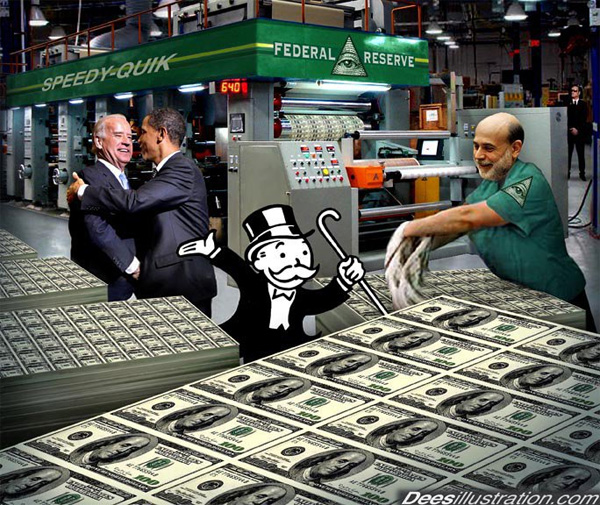
Most people think that banks lend solely from their base of deposits. Some also know that with fractional reserve banking, they can loan out many times more than they actually have in reserves.
But very few people - with the exception of those in the banking industry and financial experts - know where credit really comes from.
Germany's central bank - the Deutsche Bundesbank (German for German Federal Bank) - has admitted in writing that banks create credit out of thin air.
As the Bundesbank states in a publication entitled "Money and Monetary Policy" (pages 88-93; translation provided by Google translate, but German speaker and economic writer Festan von Geldern confirmed the basic translation)
4.4 Creation of the banks money
Money is created by "money creation". Both [central banks] and private commercial banks can create money. In the euro monetary system [money creation] arises mainly through the granting of loans, as well as the fact that central banks or commercial banks to buy assets such as gold, foreign currencies, real estate or securities. If the central bank granted a loan from a commercial bank and crediting the amount in the account of the bank at the central bank, created “central bank money.”***
Money creation by commercial banksIn other words, money is created as book-entry by purchasing assets or entering credits on the left side of the balance-sheet and corresponding deposits on the right side. In other words, credit is created out of thin air.
The commercial banks can create money itself, the so-called bank money. The money creation process through which commercial banks can be explained by the related postings: If a commercial bank to a customer a loan, they booked in its balance sheet as an asset against a loan receivable the client - for example, 100,000. At the same time, the bank writes down the customer's checking account, which is run on the liabilities of the bank's balance sheet, 100,000 euros good. This credit increases the deposits of customers on its current account - it creates deposit money, which increases the money supply.
Frontiers of money creationAs I've previously pointed out, the Federal Reserve is taking the same tack, creating conditions that guarantee that American banks will have huge excess reserves so as to prevent inflation. Back to the publication:
The above description might leave the impression that the commercial banks are able to draw an infinite amount of money in bank accounts. If this were really so, this could be inflationary. The central bank therefore takes effect on the extent of lending and money creation. It requires commercial banks to hold the reserve.
Central banks, commercial banks can typically obtain only by the fact that the central bank granted them credit. For these loans, commercial banks have to pay the central bank interest rate. Increase this rate, the central bank, the "prime rate", the commercial banks usually raise their part, the rates at which they lend themselves. There will be a general rise in interest rates. This, however, dampens the tendency of businesses and households, the demand for loans. By raising or lowering the key interest rate the central bank can thus influence the business sector demand for credit - and thus on Lending and bank money creation.Do you get it now?
The commercial banks need central bank money to cover not only for the reserve, but also to the cash needs of its customers. Each bank customer may be credit in the bank account into cash to pay off. If the stocks of the banks in cash to be in short supply, the central bank can create only remedy. Because only they are permitted to bring additional notes in circulation. To meet the cash needs of its clients, the commercial bank must therefore include, where appropriate, with the central bank for a loan. This leads to the creation of central bank money. The so-purchased assets for central bank money can pay off the commercial bank in cash let. Thus, the cash is in circulation: from the central bank to commercial banks and from these to the bank customers.
Central Bank money is also to cover the non-cash payments are required: a customer transfers money from its credit to a customer at another bank, this results in many cases led to the sending bank central bank needs to transfer money to the receiving bank. The central banks then moves from one bank to another.
***
The commercial banks can use the surplus of central bank money and to award additional credits to businesses and households. As previously described, arises from the award of additional credits additional demand for central bank money - which can be covered in this special situation of great uncertainty among banks by the existing excess liquidity. The abundant supply of liquidity relief, a bank that wants to provide a loan, from the traditional consideration of how much money they need after the award of credit is, how it is constituted, and at what cost. Using the so-called money creation multiplier can be estimated how large the potential for additional Credit limit is.
Private banks don't make loans because they have extra deposits lying around. The process is the exact opposite:
(1) Each private bank "creates" loans out of thin air by entering into binding loan commitments with borrowers (of course, corresponding liabilities are created on their books at the same time. But see below); thenIt's not just Bernanke ... the central banks and their owners - the private commercial banks - have been running the printing presses for hundreds of years.
(2) If the bank doesn't have the required level of reserves, it simply borrows them after the fact from the central bank (or from another bank);
(3) The central bank, in turn, creates the money which it lends to the private banks out of thin air.
Of course, as I pointed out Tuesday, Bernanke is pushing to eliminate all reserve requirements in the U.S. If Bernanke has his way, American banks won't even have to borrow from the Fed or other banks after the fact to have reserves. Instead, they can just enter into as many loans as they want and create endless money out of thin air (within Basel I and Basel II's capital requirements - but since governments are backstopping their giant banks by overtly and covertly throwing bailout money, guarantees and various insider opportunities at them, capital requirements are somewhat meaningless).
The system is no longer based on assets (and remember that the giant banks have repeatedly become insolvent) It is based on creating new debts, and then backfilling from there.
It is - in fact - a monopoly system. Specifically, only private banks and their wholly-owned central banks can run printing presses. Governments and people do not have access to the printing presses (with some limited exceptions, like North Dakota), and thus have to pay the monopolists to run them (in the form of interest on the loans).
See this and this.
At the very least, the system must be changed so that it is not - by definition - perched atop a mountain of debt, and the monetary base must be maintained by an authority that is accountable to the people.
Here's a translation by Scott A:
Money Creation by Banks
Money comes into existence through "money creation". Both state central banks as well as private commercial banks are able to create money. In the Euro-system, money comes into existence primarily through the origination of loans, and additionally through the acquisition of assets by central or commercial banks, such as gold, foreign currencies, real estate or securities. When the central bank extends a loan to a commercial bank and credits the amount to the [commercial] bank's account at the central bank, then "central bank money" comes into existence. Commercial banks need this in order to fulfill their fractional reserve requirements, to satisfy the demand for cash, and for their payments transactions.
Money Creation by Commercial Banks
>> Commercial banks create money through loan originations <<
Commercial banks can also create money - so-called fiat money. The process of money creation by commercial banks can be explained by the associated bookkeeping entries: When a commercial bank extends a loan to a customer, the bank makes an entry for a credit claim against the customer on the assets side of its balance sheet, for, say, 100,000 Euros. The bank simultaneously credits 100,000 Euros to the customer's checking [OR: current] account, which is entered on the liabilities side of the bank's balance sheet. This credit entry increases the deposits in the customer's account. Money comes into existence, which increases the money supply.
Fiat money created in this manner can be used by the bank to purchase goods and to pay for services. At first glance one might think that the loan customer has become richer via this creation of money. However, this is not the case, as the customer's increased balance which was created by the borrowing is offset by an obligation in an equal amount, namely the requirement to pay back the loan. In addition, the customer must continually pay interest.
The requirement to pay interest provides a strong incentive to take out a loan only in such cases where the associated resource is actually necessary. For a business, this means that what it does with the loan has to be productive, so that it's able to realize a return which at least covers the interest expense. The origination of loans and the associated creation of money lead in this way to investments, increased production, and the creation of economic value. However, this value creation is not attributable to the money creation act itself, but rather to the productive, value-creating usage of the loan, motivated by the interest.
Loan originations and fiat money creation increase the assets and liabilities of both the borrower and the commercial bank by the exact same amounts. And the bank also does not make a profit through the act of fiat money creation considered in and of itself. But the bank does earn a commission from the loan as well as from the continual interest income. This potential for profit is offset, however, by the risk that the customer might not pay back the loan. Then the bank suffers a loss. This risk provides an incentive for the bank to exercise caution when originating loans and creating fiat money. Once created, money circulates in the economy. Either it flows from account to account, when for example payments are made via transfers. Or it is withdrawn in cash from the account and then goes from hand to hand in the form of banknotes and coins. If the loan is paid off and not replaced by a new one, then the money created by it is withdrawn from circulation. In industry jargon, this is referred to as "money destruction".
Limits to Money Creation
>> The central bank can influence the volume of loan origination and money creation <<
The above description could give the impression that commercial banks have the ability to create an infinite amount of money. If that were actually the case, then it could have an inflationary effect. For this reason, the central bank exerts some control over the volume of loan origination and money creation: it requires the commercial banks to maintain fractional reserves. To illustrate this concept, the simple example from the preceding section will be continued (in reality loan originations are a bit more complicated): if the commercial bank has increased its customer deposits by 100,000 Euros by means of the loan origination, then it must also increase its fractional reserve deposits at the central bank. Since the fractional reserve rate in the Euro-system is currently 2 percent, in this case the commercial bank needs an additional 2,000 Euros in central bank money.
Commercial banks can typically create central bank money only by having a loan extended to them from the central bank. Commercial banks must pay interest to the central bank on these loans. If the central bank increases the interest rate - the "prime rate" - then the central banks in turn generally raise the interest rates on the loans which they themselves originate. This leads to an overall increase in the level of interest rates. This, however, has a tendency to dampen the demand from businesses and households for loans. By raising or lowering the prime rate, the central bank can thereby exert an influence on the economy's demand for loans - and also on loan origination and money creation.
Commercial banks need central bank money not only for their fractional reserves, but also to cover the cash needs of their customers. Every customer can have his bank account deposit paid out in cash. If banks' cash holdings become tight, then only the central bank can take remedial action - as only it is authorized to put additional banknotes into circulation: from the central bank to the commercial banks, and from them to the bank customers.
Central bank money is additionally used for the settlement of non-cash payments transactions. If a customer transfers money from his account to a customer at another bank, this often leads to a situation where the sending bank must transfer central bank money to the receiving bank. Central bank money then moves from one bank to another.
...
Commercial banks can use their surplus central bank money to originate additional loans to businesses and households. As described above, the origination of additional loans gives rise to an additional need for central bank money - which in this special situation of great uncertainty among banks can be covered by the excess liquidity already in existence. Overabundant provision of liquidity relieves a bank from the considerations it would otherwise normally make about HOW MUCH CENTRAL BANK MONEY IT WILL NEED *AFTER* ORIGINATING LOANS, how it should be obtained, and at what cost. With the help of the so-called money creation multiplier, it's possible to estimate how big the potential for additional loan originations is. [emphasis added]
Source: georgewashington2.blogspot.com