Showing posts with label afghanistan. Show all posts

Monday, April 6, 2009

Thousands flee bomb attacks by US drones

AMERICAN drone attacks on the border between Afghanistan and Pakistan are causing a massive humanitarian emergency, Pakistani officials claimed after a new attack yesterday killed 13 people.

The dead and injured included foreign militants, but women and children were also killed when two missiles hit a house in the village of Data Khel, near the Afghan border, according to local officials.

As many as 1m people have fled their homes in the Tribal Areas to escape attacks by the unmanned spy planes as well as bombings by the Pakistani army. In Bajaur agency entire villages have been flattened by Pakistani troops under growing American pressure to act against Al-Qaeda militants, who have made the area their base.

Kacha Garhi is one of 11 tented camps across Pakistan’s frontier province once used by Afghan refugees and now inhabited by hundreds of thousands of Pakistanis made homeless in their own land.

So far 546,000 have registered as internally displaced people (IDPs) according to figures provided by Rabia Ali, spokesman for the United Nations High Commissioner for Refugees, and Maqbool Shah Roghani, administrator for IDPs at the Commission for Afghan Refugees.

The commissioner’s office says there are thousands more unregistered people who have taken refuge with relatives and friends or who are in rented accommodation.

Jamil Amjad, the commissioner in charge of the refugees, says the government is running short of resources to feed and shelter such large numbers. A fortnight ago two refugees were killed and six injured in clashes with police during protests over shortages of water, food and tents.

On the road outside Kacha Garhi camp, eight-year-old Zafarullah and his little brother are among a number of children begging for coins and scraps. “I want to go back to my village and school,” he said.

With the attacks increasing, refugees have little hope of returning home and conditions in the camps will worsen as summer approaches and the temperatures soar.

Many have terrible stories. Baksha Zeb lost everything when his village, Anayat Kalay in Bajaur, was demolished by Pakistani forces. His eight-year-old son is a kidney patient needing dialysis and he has been left with no means to pay.

“Our houses have been flattened, our cattle killed and our farms and crops destroyed,” he complained. “There is not a single structure in my village still standing. There is no way we can go back.”

He sold his taxi to pay for food for his family and treatment for his son but the money has almost run out. “God bestowed me with a son after 15 years of marriage,” he said. “Now I have no job and I don’t know how we will survive.”

Pakistani forces say they have killed 1,500 militants since launching antiTaliban operations in Bajaur in August. Locals who fled claim that only civilians were killed.

Zeb said he saw dozens of his friends and relatives killed. Villagers were forced to leave bodies unburied as they fled.

Pakistani officials say drone attacks have been stepped up since President Barack Obama took office in Washington, killing at least 81 people. A suicide attacker blew himself up inside a paramilitary base in Islamabad, killing six soldiers and wounding five yesterday.

Thursday, January 22, 2009

Obama & The Coming Darkness

OBAMA MET WITH HIS WARLORDS on January 21, 2009, his very first day of his puppet-presidency. On the table for discussion was the “eventual” pull out of US troops from Iraq and the escalation of the war in Afghanistan.

The warlords present for the meeting were Secretary of Defense Robert Gates, Joint Chiefs Chairman Admiral Mike Mullen, and Central Command head General David Petraeus.

Regarding the Iraqi “pullout,” in the weeks since his election, Obama has changed course on campaign pledges expressing his willingness to be “flexible.” And that “flexibility” is owing to US commanders in Iraq insisting that there is “no way troops can be pulled out” at the rate of two combat brigades per month so as to meet Obama’s pledge of a 16 month withdrawal timeline.

Regarding the war in Afghanistan, Petraeus called for 30,000 more troops, including four combat brigades and a Stryker patrol, to arrive in Afghanistan over the next year. Obama stated that he wants to accelerate that deployment.

In his inauguration speech, Obama said that America is suffering from “a nagging fear that America’s decline is inevitable and that the next generation must lower its sights.” Obama almost got it right. America’s decline is now occurring rather than it being a future “inevitable” event. And the next generation must rather “raise its sights” 7,000 miles away, to be sent off to Afghanistan to die or be maimed in a war they neither understand nor believe in.

Obama’s explanation of America’s mission in Afghanistan is to “prevent the Taliban from launching attacks against the United States.” Any fool knows that attacks against the US from the uneven hills of Afghanistan, 7000 miles away, are an impossibility. And besides, the Taliban had nothing to do with 9/11, have no interest in being part of a second one, and wouldn’t be fighting American soldiers if the US had not started a war against them in the first place 7 years ago.

In Sun Tzu’s ancient classic, The Art Of War, he warned against a protracted war, saying, “There is no instance of a country having benefited from prolonged warfare. If victory is long in coming, then men’s weapons will grow dull and ardor will be dampened.”

The only ones to “benefit” from the Afghan war are the US defense contractors, Wall Street Jewish bankers, and the Warlords in Obama’s administration.

But the ones who will lose in Obama’s protracted and escalated Afghan war, will be the parents of the sons and daughters who will return home in body bags — whose “ardor” will not only be dampened, but extinguished.

___________________________________

For More See: Why Obama Will Fail In Afghanistan Click Here

And: Obama To Lead US To More War, Death, Genocide Click Here

Sunday, December 21, 2008

US will send up to 30,000 troops in new Afghan surge

The United States is to deploy up to 30,000 more troops in Afghanistan by next summer. The figure - a third more than had been anticipated - was announced by the chairman of the US joint chiefs of staff, Admiral Mike Mullen, and represents the highest figure mentioned publicly by a senior American official.

The confirmation of the scale of the troop surge - along with the increase in the upper limit of envisioned new forces - reflects concern over the course of the war in Afghanistan, which has been hit by numerous setbacks as security across the country has deteriorated in the face of Taliban advances.

In recent weeks Taliban attacks have severely disrupted the main supply line for US and Nato troops into the country from Pakistan, a route that carries up to 75% of supplies to foreign forces.

Washington is already sending some 3,000 extra troops to Afghanistan in January and another 2,800 by spring. However, previously officials have said that the number would be increased by 20,000 in the next 12 to 18 months, once approved by the new administration of President Barack Obama.

The increased scale of the commitment of US combat troops is bound to bring renewed pressure on the UK and other Nato partners to commit more troops: senior US military figures and officials have complained that America is shouldering too much of the burden in the war against the Taliban.

Last week prime minister Gordon Brown announced an extra 300 British troops for Helmand province after visiting troops in Afghanistan. Senior Downing Street sources then played down the prospect of further reinforcements this spring. However, Brown will be under pressure not to jeopardise a fledgling relationship with Obama if the new US president requests more British troops.

"Some 20 to 30,000 is the window of overall increase from where we are right now. I don't have an exact number," Mullen told reporters. "We've agreed on the requirement and so it's clear to me that we're going to fill that requirement. So, it's not a matter of if, but when," he said.

'We're looking to get them here in the spring, but certainly by the beginning of summer at the latest."

Half of the new US troops are expected to be deployed to southern Afghanistan, where British forces are stationed.

US Army General David McKiernan has asked for the extra troops to halt a growing Taliban insurgency, particularly in the east and south of Afghanistan.

Obama has pledged a renewed focus on Afghanistan, where US-led forces toppled the Taliban government in 2001 after the 11 September terror attacks. The United States currently has some 31,000 troops in Afghanistan, with some operating independently and others operating as part of a 51,000-strong Nato-led security assistance force.

Saturday, December 13, 2008

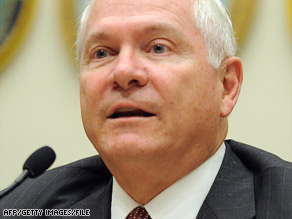
Gates: Troops staying in Iraq regardless of election

WASHINGTON (CNN) -- The United States will not likely launch another regime-changing war "anytime soon," but American troops will remain in Iraq and Afghanistan for years, Defense Secretary Robert Gates said Monday.
Robert Gates says U.S. troops in Iraq will serve in advisory or counterterrorism capacities "for years to come."
Failure in either nation "would be a disastrous blow to our credibility, both among our friends and allies and among potential adversaries," Gates said.
Speaking at the National Defense University in Washington, Gates addressed President Bush's recent decision to pull 8,000 troops out of Iraq and send 4,500 troops to Afghanistan. Gates predicted even more troops would be sent to Afghanistan next year.
"Given its terrain, poverty, neighborhood and tragic history, Afghanistan in many ways poses an even more complex and difficult long-term challenge than Iraq -- one that, despite a large international effort, will require a significant American military and economic commitment for some time," Gates said. Video Watch how new Pakistani militias are taking on Taliban and warn U.S. »
But rather than solely tapping its military capabilities, Gates said the United States also will utilize "indirect approaches" that "prevent festering problems from turning into crises that require costly and controversial American military intervention."
Gates said not to expect troops to leave Iraq after the upcoming U.S. election.
"No matter who is elected president in November," he said, "there will continue to be some kind of American advisory and counterterrorism effort in Iraq for years to come."
During his lecture, Gates also touched on the Russia-Georgia conflict, U.S. military capacity and the U.S. war on terror, which he said will require at least some direct military force.

"But we also understand that over the long term, we cannot kill or capture our way to success," he said. "Where possible, kinetic operations should be subordinate to measures to promote better governance, economic programs to spur development and efforts to address the grievances among the discontented from which the terrorists recruit." Video Watch a reality check from Iraq »
Though rogue nations and rising powers pose threats to the United States, the greatest threats to the homeland are terror networks that "find sanctuary within the borders of a weak nation and strength within the chaos of social breakdown," Gates said.
A terror attack on a U.S. city, he said, is "more likely to emanate from failing states than from aggressor states."
"In addition, there is the potentially toxic mix of rogue nations, terrorist groups, and nuclear, chemical or biological weapons," he said. "North Korea has built several bombs, and Iran seeks to join the nuclear club. North Korea is impoverished, literally starving, while Iran sits on a sea of oil. Both have primitive ground offensive capabilities and ballistic missile programs of increasing range. Both have a record of proliferation and ties to criminal groups or terrorist networks."
To combat these evolving threats, the U.S. military will need more than expensive high-tech weapons. It must adapt to "a blended, high-low mix of adversaries and types of conflict."
With ongoing operations in Iraq and Afghanistan, the U.S. military would have difficulties fighting "a major conventional ground war elsewhere on short notice," but it still wields enough firepower to "deter or punish aggression," Gates said, citing specifically the Korean Peninsula, Persian Gulf and Taiwan Strait.
However, the United States is "unlikely to repeat another Iraq or Afghanistan anytime soon -- that is, forced regime change followed by nation-building under fire," he said.
"What all these potential adversaries have in common -- from terrorist cells to rogue nations to rising powers -- is that they have learned over time that it is not wise to confront the United States directly on conventional military terms," he said.
Gates downplayed concerns that Russia has re-emerged as a threat to the United States, saying that Russia is not trying to "dominate the globe."
Russia's recent campaign against Georgia showed that "militaries do still matter," he said, but the crushing of "Georgia's tiny military" last month does not mean the United States should rearm for a Cold War.
"Remember that what's driving Russia is a desire to exorcise past humiliation and dominate their near abroad -- not an ideologically driven campaign to dominate the globe," Gates said.
While Russia's military has "vastly improved" since its decline in the last decade, it "remains a shadow of its Soviet predecessor" and Russia's demographics impede its rapid growth.
"Though Russia's recent air and naval forays into this hemisphere have grabbed headlines, it's also worth nothing that in the last 15 years, the Russian navy has launched only two new major warships," Gates said. "Russia does present serious challenges, but ones very different from the past."
Gates cited some shortcomings in U.S. military capacity, including aging fighter and refueling planes, and a ground force spread so thinly that it's unable to focus on specialties, such as the Army's field artillery corps or the Marines' amphibious operations.
"We must remedy this as soon as we can through growing the ground forces and increasing dwell time and opportunities for full spectrum training," he said.
advertisement
But never underestimate U.S. military dominance, he said. Though it is engaged in two campaigns, the military still has plenty of man- and firepower compared with other militaries. A good example is the U.S. Navy, which has shrunk considerably since the Cold War but remains bigger than the 13 next-largest navies combined.
"No other navy has anything comparable to the reach or combat power of a single American Carrier Strike Group," he said.

Saturday, November 8, 2008

The Beat Goes On: More Atrocity as Afghanistan Braces for Obama Surge

Written by Chris Floyd

While America continues its giddy, self-congratulatory celebration of "change," Afghans find themselves mired in the tragically familiar: yet another round of mourning for yet another massacre of innocent civilians in yet another blind, bludgeoning air strike by American forces.

This time almost 40 people, including 10 women and 23 children, were ripped to shreds of bone and viscera when an American missile struck a wedding party in the remote village of Wech Bakhtu, according to Washington's own hand-picked native satrap, President Hamid Karzai. As the Guardian and National Post report:
The bombing on Monday of Wech Baghtu in the southern province of Kandahar destroyed an Afghan housing complex where women and children had gathered to celebrate. Body parts littered the wreckage and farm animals lay dead.

Abdul Jalil, a 37-year-old grape farmer whose niece was getting married, said at the scene of the bombing that US troops and Taliban fighters had been fighting about half a mile from his home.

A short while later fighter planes bombed the complex, killing 23 children, 10 women and four men, he claimed.

"In the bombing, mostly women and children were killed," said villager Hyat Ullah. "Some lost their head. Some lost their hand. They were in very bad condition."
Such mass slaughters of civilians are now a regular occurrence in the occupied land. At last 18 people -- three women and 15 children -- were killed by an allied air strike in Helmand in mid-October. Some 90 civilians, mostly women and children, were killed in a night raid on the village of Azizabad in September -- an atrocity that the Pentagon at first tried, My Lai-like, to cover up completely, but was eventually forced to partially acknowledge, admitting "only" 33 civilian deaths in a report that contradicted the eyewitness evidence gathered by the Afghan government, NGOs and UN investigators who detailed the much larger true death toll. In July, Americans bombed yet another wedding party in Nangahar, killing 47 civilians -- including the bride, as the NY Times notes.

In deploring the new slaughter at Wech Bakhtu, Karzai pleaded with the incoming U.S. president, Barack Obama, to "end civilian casualties in Afghanistan" after he takes over the American war machine in January. But there is little chance of that happening. Obama has pledged to send even more U.S. troops to Afghanistan.

Obama took a great deal of heat during the campaign for brief remarks last year that actually acknowledged the carnage being wrought by U.S. strikes:

"We've got to get the job done there and that requires us to have enough troops so that we're not just air-raiding villages and killing civilians, which is causing enormous pressure over there."
His opponents, including that great "progressive," Hillary Clinton, somehow turned this into an indication of Obama's "weakness" on "defense" -- although it was in fact a forthright commitment to more war. But far more noteworthy than Obama's acknowledgment of the obvious, however, was his idea that increasing the number of American troops in Afghanistan will somehow reduce the number of bombing runs and missile strikes that are taking such a horrific toll on civilians. Because of course the opposite is true. More U.S. troops on the ground will mean more "close air support" to back them up, and bail them out, when they are under fire.

This is precisely what happened Monday at Wech Bakhtu, as the NY Times reports:

Zalmay Ayoby, a spokesman for the governor of Kandahar, said the strike on Monday took place when Taliban and American-led forces were engaged in a firefight near the village of Wech Bakhtu. He said that an air strike was called in after the Taliban opened fire on a coalition unit, and that a missile struck a compound where a wedding party was being held.
Most of the civilian slaughters by American and allied air power have occurred while in support of ground forces. It is inevitable that more ground troops will draw more fire, necessitating more air support. This in turn guarantees an increase in civilian casualties; for despite the modern myths about "precision bombing" and "smart weapons," bombs and missiles are indiscriminate killers, targeting is an inexact science -- and the lives of an occupied people are always cheap.

This is not hard to figure out. And Obama, who is, as we are constantly told -- correctly, I think -- one of the most intelligent men ever elected president, must know it. He must know that putting more troops into Afghanistan will mean "more air-raiding [of] villages and killing civilians." Perhaps he is counting on the bipartisan backing of this "good war" in the American political and media establishments (including most of the "progressosphere") to circumvent the "enormous pressures" that will inevitably be caused by his planned "surge."

Meanwhile, innocent Afghans will continue to die at the hands of their "liberators" -- even as these "liberators" blame the survivors for the attacks on their families. As the Guardian notes:

Jalil said US forces came into his village after the bombing run. "The Americans came and told us 'you are sheltering the Taliban', and I told the Americans 'come inside and see for yourself, you are killing women and children'," Jalil said.

And the National Post reports:

This latest reported attack, after a series of incidents which have killed innocent Afghans, drew anger from villagers.

"Now you can see how the Americans are coming and bombing women, children, everyone ... all innocent people," said Mohamed Asim. "I want to ask the Americans, did you come to stabilize and bring peace to our country, or have you come to destabilize and destroy our country?"

Come January, how will Barack Obama answer that question? We can only look to his own words on the campaign trail. As we noted here last month:

The Democratic candidate's stated polices on the conflict dovetail exactly with those of Rove, Bush and McCain: Thousands of more troops. More military hardware. More drone missile strikes, not only in Afghanistan but in Pakistan as well. Obama has also pledged to pressure the Europeans to send more troops and hardware of their own to Afghanistan, with "fewer restrictions" on their combat operations.
In other words, he will answer it with steel, fire and blood.

Friday, November 7, 2008

Record opium harvest in Afghanistan threatens new heroin crisis in Britain

• EU agency fears glut and reversal of deaths decline
• UK tops cocaine abuse table for fifth year in row


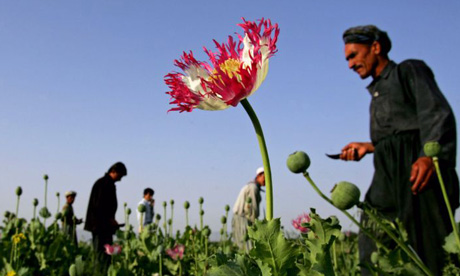
Afghan farmers in a poppy field

Afghan farmers in a poppy fi eld: Helmand province, centre of British military operations, accounts for over half of the opium crop. Photograph: Ahmad Masood/Reuters

A glut of opium on the world market, fuelled by a record Afghan harvest, threatens a new heroin crisis in Britain, the European Union's drug agency warned yesterday. The agency's annual report also confirms that the UK remains at the top of the European league table of 27 countries for cocaine abuse for the fifth year in a row. The UK accounts for 820,000 of the 4 million Europeans who have "recently used" cocaine.

But the agency also reports that there are "stronger signals" of the declining popularity of cannabis across Europe, especially among British school students.

Nevertheless the drug experts say that a quarter of all Europeans - 71 million people - have tried cannabis at some time in their lives.

The heroin warning from the European monitoring centre for drugs and drug abuse follows two record opium harvests in Afghanistan of 8,200 tonnes in 2007 and 7,700 tonnes this year. The harvests represent 90% of the world's illicit opium production with Helmand province, the centre of British military operations, accounting for over half of the crop.

"While favourable weather conditions have boosted harvests, the recurrent conflicts, because of the destruction, poverty and general insecurity that they entail, are likely to be an important factor in explaining the increases in opium production," says an agency study monitoring the supply of heroin into Europe.

The EU agency says that "alternative development" measures to persuade farmers to switch to other crops are having a very limited impact. It says that in eastern Afghanistan insecurity, lack of water, poor roads and increases in fuel costs have combined with declining prices for legal crops such as onions, which may make it difficult to sustain reductions in poppy cultivation in the future.

In Helmand, where opium poppy continues to grow in abundance, the security situation including the threat of roadside robbery and the proliferation of insurgent checkpoints make it sometimes impossible to get legal crops to urban markets.

"The latest data, while showing an overall reduction in production, point to increasing production in southern Afghanistan, in particular in Helmand province, where around 70% was produced in 2008," the study concludes.

The EU is worried that these record harvests threaten to end the "slowly improving" heroin situation in Britain and across Europe and reverse the decline seen in heroin-related deaths.

Seizures have doubled in Turkey, an important transit country, and are 20% up in Britain. The EU drug experts fear that the recent decline in heroin-related deaths in Britain - down from 2,171 in 2001 to 1,979 in 2005 - will be halted and even reversed as a result of a glut of much cheaper and possibly more potent heroin entering Britain. "Current evidence does not point to an epidemic growth in heroin problems as experienced by most of Europe in the 1990s," said the EU drugs agency director, Wolfgang Gotz. "Nonetheless, we cannot ignore the threat posed by the glut of heroin now available on the world market, the concerns raised by indicators of heroin use, or signs that synthetic heroin may be a growing problem. Vigilance is clearly required."

Britain's continuing position at the top of the league table of 27 EU countries for cocaine abuse is based on the fact that 12.7% of young adults aged 15 to 34 have used the drug.

Typical cocaine users in Britain are now just as likely to be poor working class young men as wealthy City traders.

The latest school surveys show that 5% of 15- and 16-year-olds have tried it. Cocaine use in Europe is highest in Britain and Spain. It has stabilised in both countries in recent years but at a level that is approaching American consumption. The increasing number of Europeans using the drug - 4 million last year, the EU estimates - reflects its recent growth in Italy, Denmark and Ireland.

The growing popularity of cocaine has been matched by declining use of amphetamines.

There is encouraging news about cannabis consumption in Britain. While the UK consistently had the highest levels of cannabis use among schoolchildren in the early and mid-1990s in this European survey, it has seen the sharpest decline in its popularity of any EU country.

Britain is now fourth in the Euro-league cannabis table amongst 15- to 24-year-olds, with 39.5% saying they have tried it at some time, and 12% saying they have used it in the last month.